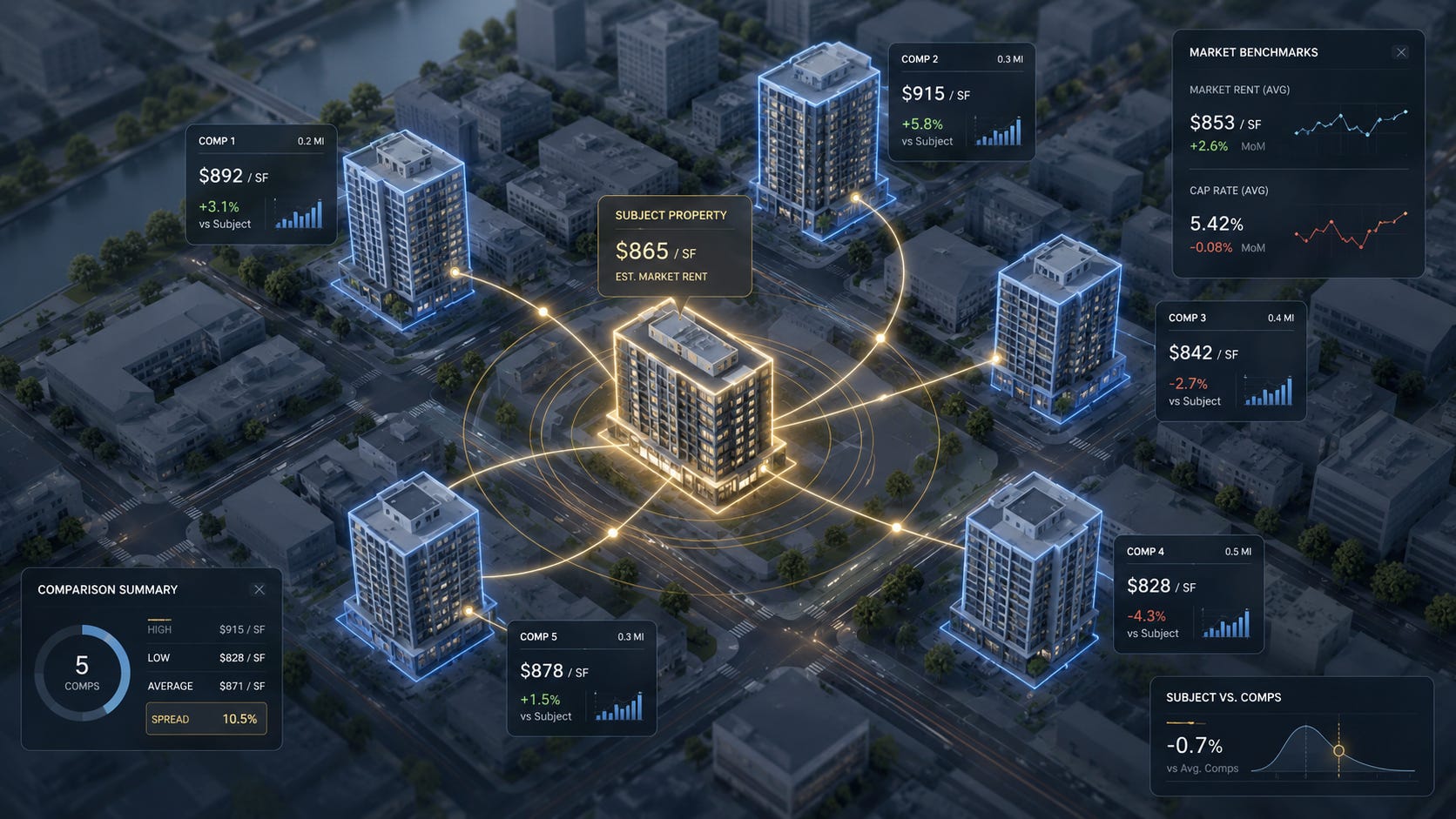
The Way Real Estate Firms Find Comparables Is About to Change
AI agents won’t replace analysts, valuers, or brokers. But they will take over much of the groundwork behind market research and valuation evidence.
It’s 9:40am on a Tuesday and a client wants a number by lunch.
They’re looking at a 2-bed apartment and they want to know if the asking price is fair before they put down a deposit. Simple question. So your analyst opens the transaction records, sets the date filter, clears the captcha, and pulls recent sales in the building’s area. Then a separate search for rents, to sanity-check the yield. Then another window to confirm the floor, the view, the parking. The first three comps that come back are still under construction. Useless for a finished unit. Back to the search.
By 11:15 there’s a spreadsheet with thirty rows in it. Half need to be thrown out. The two best comps aren’t even in the system yet, so there’s a call to a broker contact to find out what’s actually been trading this month, and another to confirm whether a deal that looks low was a distressed sale or just an old listing. The good ones that remain need adjusting for floor, finish, and the fact that two of them transacted before the market wobbled last quarter. Somewhere in there is a defensible answer.
By 12:30 you have a number. You’re reasonably confident in it. But here’s the uncomfortable part: of those nearly three hours, maybe twenty minutes were actual judgment. The rest was collection.
Whether you’re working in Dubai, London, or Dallas, this is the daily reality for most real estate firms. The tools differ, the registries differ, but the shape of the problem is identical. And it’s about to change.
Not the judgment. Not the valuation. Not the client relationship. The collection. The tab-switching, phone-calling, field-cleaning grunt work that eats the morning before the thinking even begins.
The firms that understand this distinction over the next 18 months will pull away from the ones that don’t.
Today’s Brief:
Why the market no longer rewards lazy comparables
The real problem isn’t missing data. It’s everything the data doesn’t tell you.
What an AI agent actually changes (and what it doesn’t)
A walk through that same Tuesday morning, one year from now
Why the professional moves up the stack, not out the door
Why this matters most for small and mid-sized firms
The risks, and what smart firms will do differently
The market no longer rewards lazy comparables
In a hot, vertical market, almost everyone looks smart. Prices go up, comps go up, and a rough estimate gets validated by momentum.
That era is ending in most major markets at once.
Take Dubai, arguably one of the most active markets in the world. Despite the recent geo-political challenges which has undoubtedly effected velocity and volume of activity, everyone who lives in the data has been calling a market correct for the past 12 months. CBRE’s Q1 2026 review describes a more complicated picture underneath: over 45,000 residential transactions worth AED 137 billion, heavily off-plan, but with price and rental growth moderating and “a more cautious approach among some investors.”
The same caution is everywhere. In the US, the National Association of Realtors reported existing-home sales running near multi-decade lows through 2025, with buyers and sellers locked apart by a wide spread between asking and achievable prices. In the UK, the post-rate-shock market has spent two years grinding through a slow, uneven recovery where two near-identical flats on the same street can transact at meaningfully different prices depending on timing and condition.
Think about what that does to the Tuesday-morning problem above.
In a rising market, a sloppy comp is forgiving. Momentum bails you out. In a flat or choppy market, the gap between a good comp and a lazy one is the gap between winning the mandate and mispricing the deal. The adjustments matter more. The timing of each comp matters more. The thin spots in the evidence matter more.
This becomes even more important for cross-border and institutional capital,. Wherever it lands, needs credible, source-backed evidence. It can’t run on a gut feel.
The real problem isn’t missing data. It’s everything the data doesn’t tell you.
This is the part most people get backwards.
The common complaint is “we don’t have the data.” In most developed markets, the registry data exists. The US has it across county recorders, the MLS systems, and aggregators like CoStar. The UK has HM Land Registry’s Price Paid Data. Dubai is, if anything, ahead on raw availability: the Dubai Land Department’s open data platform already exposes transactions, rents, projects, valuations, land, buildings, units, brokers, and developers.
So the raw transaction record is there. The problem is that good comparables were never just the transaction record. And the gap between the two is where real estate professionals lose their week.
First, there’s a time lag. A deal agreed today doesn’t hit the public registry today. Depending on the market, there’s a delay of weeks or months between a transaction being struck and it showing up in official data. In a flat market that’s an inconvenience. In a moving market it’s a serious problem, because the most relevant comps, the ones that actually reflect where pricing is right now, are precisely the ones not yet visible in the registry.
So what do professionals actually do? They pick up the phone. They call brokerages, ask contacts what’s just traded, and chase off-market and just-agreed deals that haven’t surfaced anywhere official yet. This off-market comp hunting is one of the most time-consuming, least scalable parts of the job, and it depends entirely on who you know and who picks up.
Second, the registry doesn’t tell you the story behind the number. A transaction record gives you a price, a size, a date. It doesn’t give you any of the things that actually determine whether that price is a usable comparable:
What was the seller’s motivation? A distressed seller and a patient one produce very different numbers for the same unit.
What was the buyer’s appetite? Was this a competitive situation with three bidders, or one motivated buyer and a quiet listing?
What was the negotiation? Did it transact at asking, or 12% below after two months on the market?
None of that is in the data. It lives in the heads of the brokers who did the deal. Which is, again, why professionals end up on the phone.
Third, even the on-registry data is fragmented by design. Sales live in one place, rents in another, project and building attributes in another, and historical data often in a different system entirely. Most of it sits behind a login, a captcha, or a mandatory filter. The richer operational layer, tenancy records, listing validation, rental indices, exists but is gated behind paid, role-restricted APIs that a boutique firm can’t justify.
So the picture is this. Good comparables require three different kinds of work: pulling the official record, chasing the recent and off-market deals the record hasn’t caught up to yet, and gathering the context that explains what each number actually means. Today, all three are manual. Most of a professional’s “comp time” isn’t analysis. It’s hunting, calling, reconciling, and stitching fragments together before a single judgment gets made.
The real insight: The future of finding comparables is not one magical dataset. The data is incomplete by nature, the freshest signals live off-market, and the story behind each number lives with people. The opportunity isn’t a better database. It’s one workflow that gathers the official record, surfaces the recent and off-market signals, and structures the context around each comp, so the professional starts from an assembled picture instead of a blank spreadsheet. That is exactly what AI agents are built for.
What an AI agent actually changes
Let’s be precise, because “AI agent” is fast becoming the most abused phrase in the industry.
A chatbot answers a question and the exchange ends. IBM defines an AI agent differently:
An AI agent is a system that autonomously performs tasks by designing its own workflow and using the tools available to it. It can plan, call external datasets and APIs, hold context across steps, and iterate toward a goal.
That maps almost perfectly onto how comparables get built. The real workflow is a chain:
Take the client brief
Pull the official sales and rent records
Surface recent and off-market activity not yet in the registry
Check the relevant unit, building, and project details
Gather the context around each comp, listing history, time on market, any known deal circumstances
Validate the listing or broker where needed
Add market-cycle and risk context
Clean, reconcile, and compare everything
Select the comparables
Write the source-backed narrative
An agent takes over steps two through eight far better than steps nine and ten. It gathers, reconciles, structures, and annotates the evidence across fragmented systems faster than any human working tab-by-tab, and it can flag where the gaps are, the comps that are too old, the ones missing context, the just-agreed deals worth a human follow-up call. The human keeps the selection and the narrative.
And you don’t need a science-fiction swarm. Microsoft’s architecture guidance is clear that for most enterprise use cases, a single agent connected to the right tools is the correct default. A comp workflow, at least to start, is a single-agent-with-tools problem.
That same Tuesday morning, one year from now
Here’s what the walk-through looks like once the groundwork is automated. The specifics below use a Dubai example, but swap the registry names for Land Registry and the MLS and the morning plays out the same in London or Chicago.
9:40am. The same client, the same 2-bed, the same “is this fair?” by lunch.
Your analyst types one line:
“Build me a comp pack for a 2-bed, ~1,250 sq ft, mid-floor, in this community. Finished units only. Last 6 months.”
9:41am. The agent gets to work. It pulls recent transactions for that area, filters to completed stock, and automatically discards the under-construction tower that polluted last year’s search. It cross-references each comp against the building and unit datasets, floor, layout, parking, so it’s comparing like with like. It pulls the matching rent registrations to compute the implied yield. It surfaces the listing history and time-on-market for each comp, and flags two recent deals that look relevant but aren’t fully reflected in the registry yet, worth a confirming call. It also notes that two of the strongest comps transacted before the market softened.
9:46am. The output lands. Not a number. A structured evidence pack: eight ranked comparables, each one hyperlinked back to its source record, each adjustment shown and explained, with the thin spots called out in plain language.
“Comp 3 is a strong match but pre-dates the recent softening; treat with caution. Comp 7 has a superior view; adjust down ~4%. Two off-market deals flagged below, registry data pending, confirm with broker before relying.”

9:50am. Now the analyst does the part that actually pays. They make one call to confirm the two off-market deals, because that judgment about which sources to trust is theirs. They look at the eight comps and decide which four genuinely matter. They know Comp 5’s building has a service-charge issue the data doesn’t show. They know the client’s unit faces the wrong way. They make the judgment calls the agent couldn’t, adjust the range, and write two sentences of context for the client.
10:05am. The number is done. Defensible, sourced, and signed off by a named professional. The client has it well before lunch.
That’s the shift. Not three hours of collection and twenty minutes of judgment. Five minutes of assembled groundwork, one targeted call, and the rest spent on the thinking that clients actually pay for.
This is the unglamorous truth about where AI delivers real ROI in property: not the dramatic stuff, but the rule-bound, data-heavy 80% of the research process. The blank spreadsheet, and the phone-tag that surrounds it.
The professional doesn’t disappear. They move up the stack.
I want to be direct here, because this is the part that decides whether you feel threatened or excited.
The valuer, the analyst, the advisor, the broker - none of them get replaced. They move up. Less time collecting evidence, more time deciding which evidence matters, what to adjust, how to caveat, and how to explain it. And notice what doesn’t go away in the walk-through above: the call to confirm the off-market deals. The relationships and the judgment about which sources to trust stay firmly human. The agent just makes sure that call is the only one you need to make, not the tenth.
And maybe. Just maybe. There’s a future where your AI agent calls a brokers AI agent and gets the data that way…
The professional-standards world is, unusually, ahead of the technology, and it points the same way, globally. On 9 March 2026, RICS’s first global professional standard on the responsible use of AI in surveying came into force for all members and regulated firms worldwide, not just in the UK.
It does not tell firms to avoid AI. It tells them to keep control of professional work, preserve professional judgment, manage output reliability, and stay transparent with clients. It explicitly names the failure modes, including loss of data provenance, hallucinations, and human-in-the-loop bypass. Where AI materially affects the work, it requires a documented, supervised reliability decision signed off by a named professional.
Read that carefully and the thesis of this article is written into the regulation: the machine does the groundwork, a named human owns the opinion.
The behavioural data agrees, across markets. Microsoft’s 2026 Work Trend Index, surveying 20,000 knowledge workers across 10 countries who use AI at work, found that 66% say AI lets them spend more time on high-value work, 58% are producing work they couldn’t have a year earlier, and 86% treat AI output as a starting point, not a final answer.
AI will not replace the valuer. It will replace a growing share of the unrewarding work the valuer does before the valuation begins.
Why this matters most for small and mid-sized firms
Now the part that actually matters for this audience.
Large firms have always had a research advantage. They can spread junior analysts, offshore support, expensive subscriptions, and specialists across a big revenue base, and throw bodies at the evidence-gathering. They also have the deepest broker networks, which means the off-market intelligence that’s so hard to get flows to them first. A boutique advisory or a family-office team of four cannot match either.
This is true in every fragmented, competitive market. Dubai is a useful illustration because the competition is so dense. But a small advisory in Manchester or a three-person investment shop in Austin faces the same structural disadvantage against the national firms. Leverage isn’t a nice-to-have. It’s survival.
This is the real promise of agents for smaller firms, and it has nothing to do with sounding futuristic. It’s process leverage. A well-built evidence agent behaves like an internal research analyst, a research coordinator, and a documentation assistant combined, for a team that could never afford to hire all three. It won’t replace the relationships that surface off-market deals, but it does close the gap on everything else, so the small firm’s scarce human time goes to the calls that actually need a human.
Think about what cloud software did for IT. It let small companies access infrastructure that once required their own data centre and a team to run it. Evidence agents do the same for boutique real estate research, letting a small team access the process sophistication that used to require headcount.
Do less with more. Try Buildable live
But the window is finite. Microsoft found that only around one in three AI users say their leadership has a clear vision for AI, and that organisational factors, not individual ones, decide whether AI delivers value. The firms that build the workflow now capture the gap. The ones that wait until it’s obvious will be competing against operators who already restructured around it.
The risks, and what smart firms will do differently
“AI hallucinates, so you can’t trust it for valuation.”
Correct, if you ask it for the final opinion unsupervised. That’s why the whole framing here is groundwork with citations and human review, not automated sign-off. The agent fetches, structures, and flags the gaps; the professional decides.
“The data isn’t open enough.”
Partly true, everywhere, and as we’ve seen, the registry was never the whole picture anyway. The richest layer, the gated APIs and the off-market intelligence, is paid, restricted, or relationship-bound. So the honest positioning is an orchestration layer across the data you can access, plus a clear flag on what still needs a human call, not a promise of universal access.
“Valuation is regulated, you can’t automate it.”
Regulation is the reason to build it carefully, not the reason to avoid it. RICS itself notes that minimum professional indemnity wording doesn’t exclude AI used in support of normal business practice, though insurers increasingly want business-grade tools rather than consumer ones. Provenance, audit trails, and client transparency are the features that make this defensible.
“In a softer market, historical comps go stale fast.”
Yes, and that’s exactly the time-lag problem. Which is an argument for faster, repeatable workflows that flag staleness and surface the freshest signals, not against them. The value of refreshing a comp pack in five minutes goes up when the market is moving.
The governance answer to all of these is the same: private deployment, business-grade tooling, permissioned access, logged provenance, and a named human signing the conclusion. Build it that way, and the regulatory environment becomes a moat rather than a threat.
This article was not meant to be a sales pitch. But I built a tool last year that does exactly this - Buildable. And I’m incredible passionate about giving investment analysts, valuers, and anyone that lives in the data, access to tools and workflows that make their life easier.
Buildable Isits in the layer between raw market data and professional judgment. It isn’t trying to replace the analyst, valuer, or broker, and it isn’t trying to replace the broker call that uncovers what really happened in a deal. It’s trying to remove the blank spreadsheet, the hours spent pulling transaction evidence, checking building and project details, benchmarking rents, chasing what’s already in the system, and formatting it into something a professional can actually use and verify, with the gaps clearly marked.
The value isn’t “AI decides.” The value is that the groundwork becomes faster, more structured, and easier to audit, which is exactly what produces that 9:46am evidence pack.
The bottom line
None of this is happening in a vacuum.
Governments are moving faster than most firms. In April 2026, the UAE Cabinet announced a framework to deploy agentic AI across 50% of government sectors, services, and operations within two years, describing AI as an “executive partner” that analyses, decides, and executes in real time. Whatever your jurisdiction, the direction of travel is clear: the infrastructure around this market is shifting toward autonomous systems at the level of national policy, not just startup pitch decks.
So the question for any real estate firm in 2026 is no longer whether AI changes how comparables get found. The regulation and the productivity data have already answered that.
The data exists, but it was never the whole story. The workflow that fills the gaps is broken. The regulation now expects a human to own the opinion.
Everything in between, the collection, the off-market hunt, the reconciliation, the first draft of the evidence, is up for grabs. And in a market this competitive, the firms still doing that work by hand in eighteen months won’t just be slower than their competitors.
They’ll be invisible to the mandates that matter.
Thanks for reading.
If you haven’t subscribed yet and you want articles like this in your inbox once a week for free, join us below.
Want to go deeper?
This issue is part of our ongoing work at Buildable: helping real estate teams find better comps, structure stronger evidence, and create market research outputs faster using AI.
If your team regularly produces comps packs, valuation evidence, market research, benchmarking reports, or investment notes, you can apply for a free AI Comps Workflow Audit. Just mention it in the form below.


