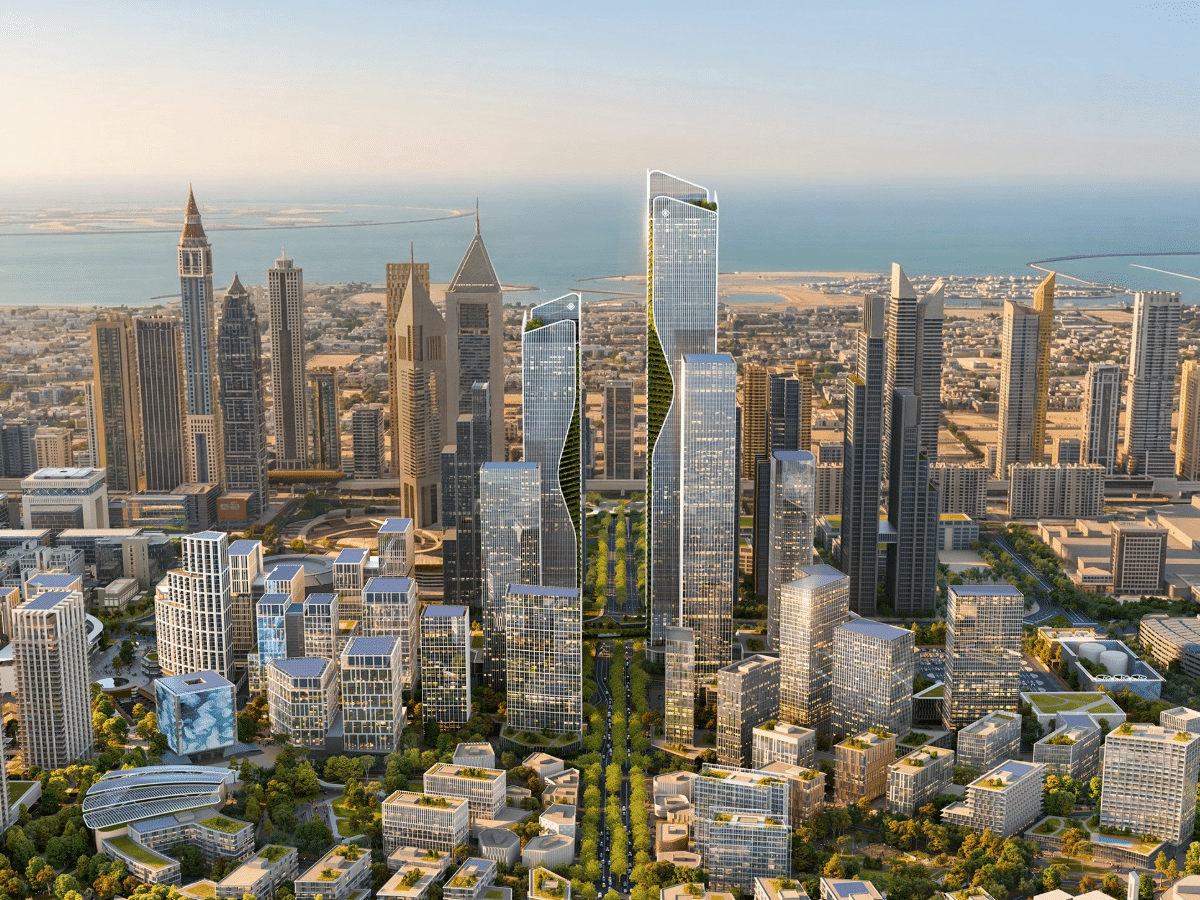
The Next Palm Isn’t an Island. It’s a District.
DIFC’s $27B “Zabeel District” is a master-developer playbook upgrade.
On 27 January 2026, Sheikh Mohammed bin Rashid Al Maktoum announced the largest expansion in Dubai International Financial Centre’s (DIFC) history: a AED 100+ billion (roughly $27.2 billion) development called Zabeel District.
The numbers are staggering:
17.7 million square feet of gross floor area. A capacity to more than double DIFC’s current footprint
From 6,920 active companies to over 42,000, and from 46,078 workers to a workforce exceeding 125,000.
A purpose-built AI campus spanning over one million square feet.
Six phases, with public access beginning in 2030 and full completion by 2040.
Why do I find this interesting? Because it’s a calculated attempt to manufacture an exportable AI-and-finance services base from scratch. And it arrives at a moment when DIFC is operating at 99.8% occupancy, with prime office rents across Dubai rising 10% in Q1 2025 alone.
The thesis: Zabeel District represents a fundamental shift in Dubai’s city-making playbook - from building tourism icons (Palm Jumeirah) to engineering economic ecosystems. If executed well, it could become the defining financial-district project of the 2030s. If it stumbles into global office headwinds or loses policy coherence, it becomes a cautionary tale about overreach.
Today’s Brief:
Why this isn’t “just another mega-project” - the demand case
The real mechanics of how DIFC makes money from concrete
Global playbook: what Canary Wharf, Hudson Yards, and Marina Bay got right (and wrong)
The land-value and corridor story that nobody’s talking about
The risks the glossy brochures won’t mention
What this means for developers, investors, and operators over the next decade
P.S. My startup, Buildable, is transforming the way Dubai real estate developer, investors, and advisors research and analyse the market.
We do AI-powered market research, comparables and benchmarking, feasibility studies, valuations, and more.
If you’re looking at the Dubai market and you want faster, smarter decisions, book a call with me.
From Island Icons to District Engines
Palm Jumeirah worked because it was visually unforgettable. An island shaped like a palm tree, visible from space, instantly recognisable in any travel magazine. It elevated property values across nearby areas, triggered follow-on mega-projects (Palm Jebel Ali, Palm Deira), and essentially created Dubai’s luxury-destination brand.
The economic chain was straightforward: bold physical icon → global attention → tourism and second-home demand → capital inflows from high-net-worth individuals → land value uplift → private-sector build-out around the original state-backed project.
Zabeel District is different. The “icon” here isn’t a recognisable skyline shape - it’s the density of funds, AI firms, and universities clustered in one contiguous district. The value proposition isn’t “look at this” but “work here, and you’re plugged into the ecosystem that matters.”
This represents a meaningful evolution. Tourism-driven branding depends on continued visitor growth and lifestyle appeal. Talent-infrastructure branding depends on regulatory stability, network effects, and the compounding value of clustering high-value firms together. One is more vulnerable to changing tastes; the other builds moats.
The explicit targets tell the story: 6,000+ businesses and 30,000 tech specialists in the AI campus alone. An education capacity expansion to 50,000 learners annually through DIFC Academy. The goal is to become a self-contained “city within Dubai” by 2040 - with its own housing, education, cultural programming, and AI-driven industries.
Is This Really “Demand-Led”?
The official framing calls Zabeel District a “demand-led expansion.” Sceptics will say that every mega-project claims to be demand-led. So let’s look at the actual numbers.
DIFC’s 2024 results paint a picture of genuine capacity constraints:
6,920 active companies, up 25% from 5,523 in 2023 - a record 1,823 new registrations in a single year
46,078 workforce, up 10% year-on-year
Technology and innovation firms grew 38% to 1,245 companies - the fastest-growing segment
99.8% occupancy across DIFC-owned and managed properties
AED 1.78 billion revenue and AED 1.33 billion operating profit
Knight Frank’s H2 2024 Dubai Office Market Review confirms the picture from an external vantage point: prime office occupancy in DIFC and other key business districts is running between 95% and nearly 100%. Average office lease rates across key submarkets rose 9.1% in H2 2024.
The tenant mix is also diversifying, which matters for resilience. DIFC now hosts 410 wealth and asset managers, including 75 hedge funds (48 of which manage over $1 billion). Over 800 family-owned businesses. 260+ banking and capital markets companies. 125 insurance and reinsurance firms.
So what: Combining near-full occupancy, double-digit company and workforce growth, and an expanding roster of hedge funds, family offices, and tech companies, there’s a defensible case that Zabeel District is being timed into a real capacity shortfall rather than built purely for signalling. DIFC’s own disclosures about introducing 1.6 million square feet of new commercial space (DIFC Square, Innovation Two, Immersive Tower) even before Zabeel are strong evidence that existing inventory is effectively full.
This distinguishes it from more speculative mega-projects launched at points of weaker underlying usage.
How DIFC Makes Money from Concrete
Understanding Zabeel’s economics requires understanding DIFC’s unusual position: it’s simultaneously a regulator, a landlord, and a developer. This triple role creates value-capture mechanisms that pure-play developers can’t replicate.
The legal architecture matters. DIFC operates under its own Real Property Law and Strata Title Law, enacted in 2007, which guarantee freehold ownership and strata regimes within DIFC’s jurisdiction. A 2018 MoU with Dubai Land Department allows DIFC entities to own and register real estate in Dubai’s designated foreign-ownership areas, integrating DIFC structures with the emirate-wide property system.
This means DIFC captures value through three channels:
Land and development margins on projects it sponsors (similar to existing DIFC-branded towers)
Recurring rental and service-charge income from office, retail, and residential assets it holds
Indirect economic rents via licence fees, regulatory revenues, and ecosystem growth that strengthen DIFC’s financial performance
The financial results show this working: AED 1.78 billion revenue and AED 1.33 billion operating profit in 2024. That’s a 75% operating margin - exceptional for any real estate entity.
The near-100% occupancy and rising prime rents imply that additional phases in Zabeel District could be underwritten at relatively strong yields compared with global peers where office vacancy sits lower. This enhances the value of DIFC’s future recurring income streams and of any developer-partners that secure early plots.
Who wins from this structure?
DIFC and Dubai-linked entities are best placed to monetise the uplift via land sales/leases, JV stakes, and long-term rental income
Institutional developers and REITs that secure office, hotel, and branded residential plots in early phases are likely to benefit from compressed yields and capital appreciation - similar to early entrants in Palm Jumeirah and Downtown Dubai once the district’s identity was established
Brokerage, design, and infrastructure firms will see sustained demand across the six-phase, 15-year build-out - especially those aligned with AI, sustainability, and mixed-use urban placemaking
The Global Playbook: Lessons from District-Making
Zabeel District isn’t being built in a vacuum. Other financial centres have attempted similar district-making projects with varying degrees of success. The lessons are instructive.
Canary Wharf (London) was conceived in the late 1980s to regenerate derelict Docklands and relieve pressure on the City. The early 1990s saw first towers open, but a property crash and financing difficulties led to developer bankruptcy before reorganisation. Full maturation took 20–30 years.
What worked: Heavy transport investments (Jubilee Line, DLR, Crossrail) and long-term commitment allowed eventual success.
What failed: Early phases suffered high vacancy and financial distress when large office supply hit during downturns.
Hudson Yards (New York) aimed to unlock underused rail yards on Manhattan’s West Side. Major construction began around 2012; the first phase opened in 2019.
What worked: Integrated mixed-use (office, residential, retail, public space) and transit connections (7 Line extension) created a new high-end submarket.
What failed: Cost overruns, public subsidies, and pandemic-era office headwinds that slowed leasing.
Marina Bay Financial Centre (Singapore) expanded Singapore’s CBD through land reclamation. Phases were largely completed between the late 2000s and early 2010s.
What worked: Strong state-led planning, clear financial-hub positioning, robust transport (MRT), and tight controls produced a high-intensity core that’s now a global benchmark.
What failed: Relatively little - but high capital intensity and reliance on a narrow high-end tenant base are structural risks.
La Défense (Paris) was a post-war effort to build modern office space outside historic Paris.
What worked: Large-scale clustering of corporates in a recognisable business district.
What failed: Monofunctional planning made it vulnerable to cyclical vacancy and perceptions of being less vibrant than mixed-use central neighbourhoods.
Five lessons for Zabeel:
Transport is destiny. Every successful analog required heavy investment in metro/rail connectivity. Zabeel’s promised “futuristic transport” and loop concept will need concrete, funded RTA schemes to avoid car-dependency and potential underperformance. If you’ve ever had a meeting at DIFC (I do this daily), you’ll understand the traffic problems!
Phasing and flexibility matter. Canary Wharf’s initial bust and Hudson Yards’ pandemic challenges underscore the need to phase supply and enable asset repurposing if global office demand shifts. DIFC’s six-phase plan to 2040 gives some flexibility - but still carries long-cycle risk.
Mixed-use resilience wins. Districts that deliberately mix office, residential, retail, culture, and education weather shocks better than monofunctional office parks. Zabeel’s residential, hotel, retail, education, and art components align with this playbook.
Anchor tenants and ecosystems are non-negotiable. Success depends on securing anchor tenants and ecosystems (global banks, tech giants, funds). DIFC’s existing base of banks, hedge funds, family offices, and AI/fintech firms gives it a stronger “bench” than greenfield projects—but it still needs to convert this into long leases in Zabeel.
Policy consistency underpins everything. Long-running policy support (tax regimes, visas, regulatory stability) is the bedrock. Any abrupt changes in Dubai’s fiscal or visa environment could impact Zabeel’s absorption trajectory despite current momentum.
The Land-Value Story Nobody’s Talking About
Here’s an angle that deserves more attention: Zabeel District physically welds DIFC’s institutional fabric deeper into Zabeel, connected by a signature bridge, with new mixed-use stock.
The implication: Grade-A assets and future plots along the SZR-Zabeel axis will likely re-price as “near-core DIFC” in a way analogous to how Downtown Dubai and Business Bay benefited from the Burj Khalifa/Dubai Mall cluster.
Knight Frank data shows that 17 Grade-A assets on Sheikh Zayed Road already average 95.4% occupancy. When Zabeel District matures, expect a tiered land-value gradient anchored by DIFC Gate–Zabeel, with premium pricing extending along the corridor.
This matters for investors thinking about where to deploy capital over the next 5–10 years. The play isn’t necessarily to wait for Zabeel to be built - it’s to identify assets in the adjacent corridors that will benefit from proximity to an expanded DIFC ecosystem.
The same dynamic played out around Palm Jumeirah: early entrants in adjacent areas like Dubai Marina captured appreciation as the Palm’s brand halo expanded. Expect something similar along the DIFC–Zabeel–SZR axis.
The Risks the Brochure Won’t Mention
Any honest assessment requires acknowledging what could go wrong. The very things that make Dubai attractive - growth, flexibility, expatriate-driven demand - also create risks that don’t exist in mature Western markets.
Global office demand post-COVID. US office vacancy sits around 19.9% in March 2025, with tech hubs exceeding 25%. Hybrid and remote work have stabilised - not disappeared. While Dubai currently bucks the trend with rising rents and high occupancy, this divergence may narrow over a 15-year horizon if global tenants rationalise footprints.
Oversupply and timeline risk. Knight Frank projects 8.2 million square feet of prime supply for Dubai between 2025 and 2028 - 86% above the 2021–2024 period. Then Zabeel adds 17.7 million square feet through 2040. A global or regional downturn coinciding with one of Zabeel’s delivery phases could mean elevated vacancy or discounted rents in some towers.
Financing uncertainty. Public disclosures don’t detail Zabeel’s funding structures or JV partners. We don’t know how much risk sits on DIFC/Dubai balance sheets versus private developers. This matters if global conditions tighten and later phases require refinancing.
Regulatory and policy risk. Dubai’s attractiveness to hedge funds, family offices, and tech firms rests partly on favourable tax treatment, legal certainty, and visa regimes. Any shift toward higher taxation, tighter AML enforcement that materially raises friction, or more restrictive migration rules could slow inflows - even if DIFC’s legal framework remains robust.
Competitive pressure. Riyadh’s financial district ambitions and Singapore’s continued strength mean the Gulf isn’t competing in a vacuum. Zabeel needs to deliver not only real estate but a superior regulatory and lifestyle package to capture mobile capital and talent.
What This Means for the Next Decade
By 2040, DIFC aims to function as a city within Dubai. 42,000+ companies. 125,000+ workers. Residential communities. A 50,000-learner education hub. An AI campus hosting 6,000+ businesses. Cultural programming and landmark art.
That’s not a real estate project. It’s an economic engine with a real estate wrapper.
For developers: The time-arbitrage opportunity is real. Early phases will be underwritten against today’s tight-supply, high-rent context. Later phases will price against whatever the 2030s global office and capital markets look like. Developers who secure plots or JVs in initial phases - while demand is clearly constrained - face lower risk than those who enter later when macro conditions may be less favourable.
For investors: Zabeel signals that Dubai’s premium real estate thesis is evolving from “sell to individual buyers” toward “build income-producing assets at institutional scale.” The district’s program mix (office, residential, hotel, retail, education) creates multiple entry points depending on risk appetite and hold period.
For operators: The 15-year build-out creates sustained demand for property management, hospitality operations, and specialised services. The AI campus and tech clustering will require PropTech and operational infrastructure that doesn’t fully exist yet - creating opportunities for first movers.
The biggest question: Can Dubai sustain the policy coherence, transport investment, and talent magnetism required to absorb 17.7 million square feet over 15 years?
If yes, Zabeel District becomes the template for 21st-century financial-district development - not icons for tourists, but infrastructure for talent. A playbook other emerging markets will study and attempt to replicate.
If no, it becomes another cautionary tale about the gap between announcement and execution in mega-project real estate.
The 2030 first-phase opening will tell us which direction this is heading. Until then, the demand case is real, the capacity constraint is genuine, and the opportunity for early movers is sitting in plain sight.
Until next time,
Zakee
P.S. My startup, Buildable, is transforming the way Dubai real estate developer, investors, and advisors research and analyse the market.
We do AI-powered market research, comparables and benchmarking, feasibility studies, valuations, and more.
If you’re looking at the Dubai market and you want faster, smarter decisions, book a call with me.


Fascinating analysis of Dubai's development strategy. The comparison between DIFC's expansion model and traditional island developments like The Palm really highlights how Dubai is evolving its approach to mega-projects. The focus on creating a functional business district rather than just a tourism landmark shows maturity in urban planning.
The distinction between tourism branding vs talent infrastructure is spot on. Most coverage misses how the triple role (regulator-landlord-developer) creates compounding value capture that pure-play developers cant replicate. Saw similar dynamics in Singapore but DIFC's 75% operating margin really underscores how rare this model is.