


By 2030, 50% of all new warehouses built in developed markets could be designed as “robot-centric” facilities, with humans increasingly there to deal with exceptions rather than form the basis of day-to-day operations.
That is the latest prediction from Gartner. Not that warehouses will use more automation, or that robots will help people pick boxes faster. But that half of new facilities could eventually be designed around the assumption that the humans are optional.
It sounds futuristic. Except quite a lot of the future is already here.
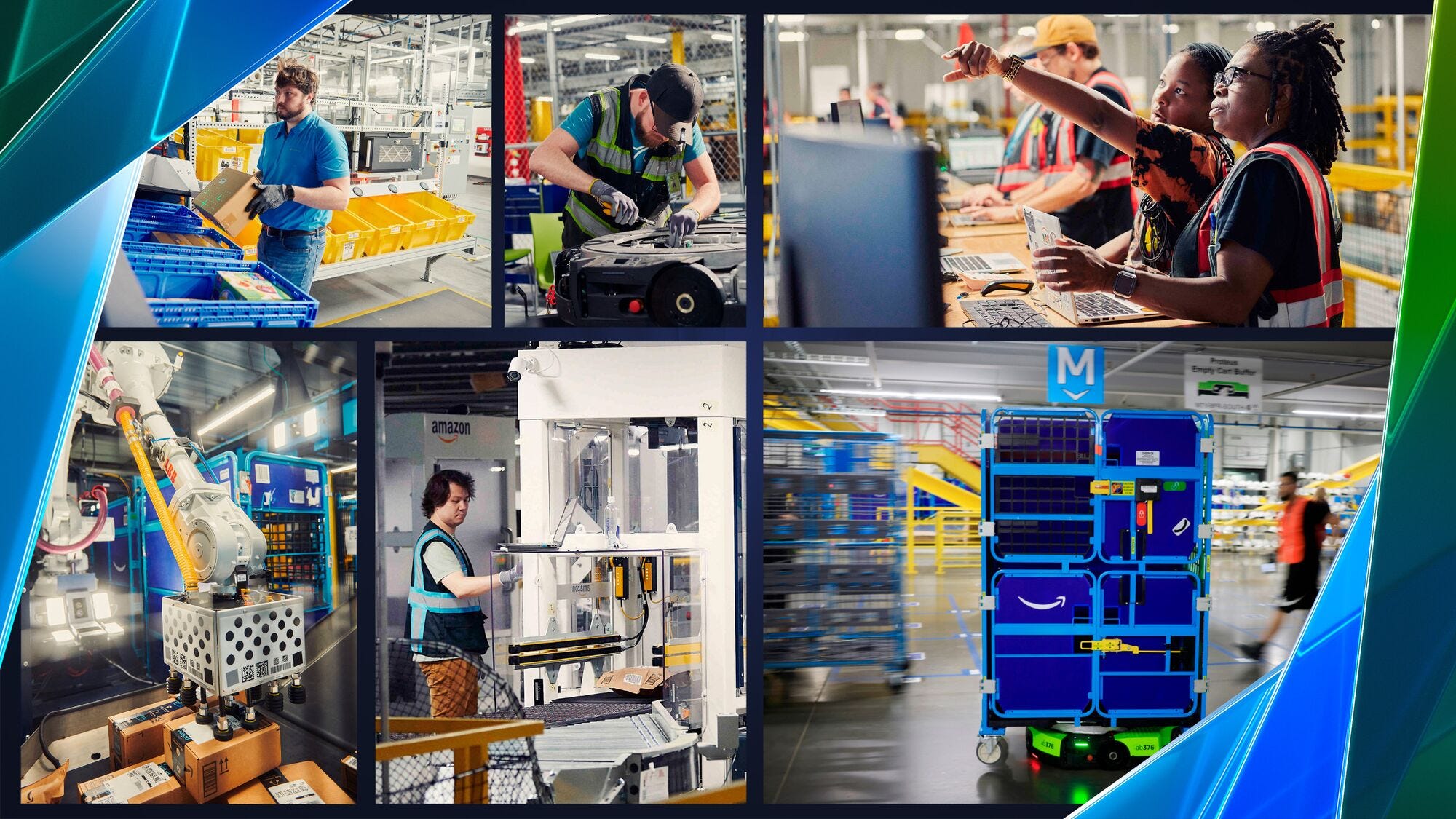
Amazon has now deployed more than one million robots across more than 300 facilities. Robots already play a role in completing 75% of Amazon customer orders, while its new DeepFleet AI system has improved robot travel efficiency by 10%.
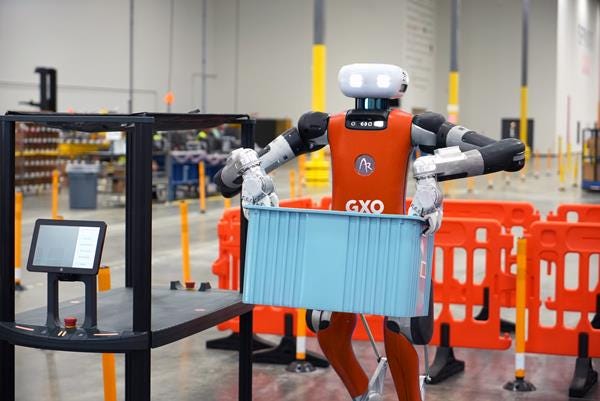
GXO already has humanoid robots commercially deployed inside a live warehouse. Locus Robotics has launched a system that it says can reduce manual fulfilment labour by up to 90%. And in Western Sydney, Aldi has received approval for a A$1 billion distribution centre where around 80% of operations will be automated.
This is usually discussed as a technology story. I’m discussing it as a real estate story:
The logistics industry has spent decades asking how to get enough people to warehouses. It may soon need to ask a different question: what happens when the warehouse barely needs them?
We built the warehouse around the worker
Almost every warehouse in the world was built around one basic assumption: people work there.
That assumption influences much more than the staff cost in an operating model. People need lighting, heating or cooling, parking, toilets, break areas and safe circulation routes. Warehouse layouts need to accommodate forklifts and employees moving alongside one another. Goods need to be stored and picked in ways humans can actually operate.
It also affects where the warehouse gets built.
CBRE’s latest European occupier research found that labour shortages remain one of logistics operators’ biggest challenges and that labour availability has become the most decisive factor in location decisions. At the same time, 53% of respondents said they now prioritise modern warehouses over traditional stock when expanding or relocating.
So underneath many warehouse investment decisions sits a piece of infrastructure we rarely describe as infrastructure: a sufficient supply of people willing and able to work there.
Gartner’s robot-centric warehouse begins to unwind that assumption. Its forecast envisages autonomous facilities operating with reduced lighting and climate requirements, and software-managed environments where workflows/robot fleets “reconfigure” themselves. Scary stuff.
I’m curious as to how this will affect valuations..?
The robots are already inside
The easiest mistake with this topic is to imagine humanoid robots walking around some futuristic warehouse in 2035.
Most of the automation changing warehouses today looks nothing like us.
Amazon’s next-generation fulfilment centre in Shreveport, Louisiana uses 10 times more robotics than its previous generation of facilities. Amazon says those next-generation systems have already reduced fulfilment processing times by up to 25%.
The important bit isn’t simply that Amazon uses lots of robots. It is that the technology is increasingly influencing the building itself.
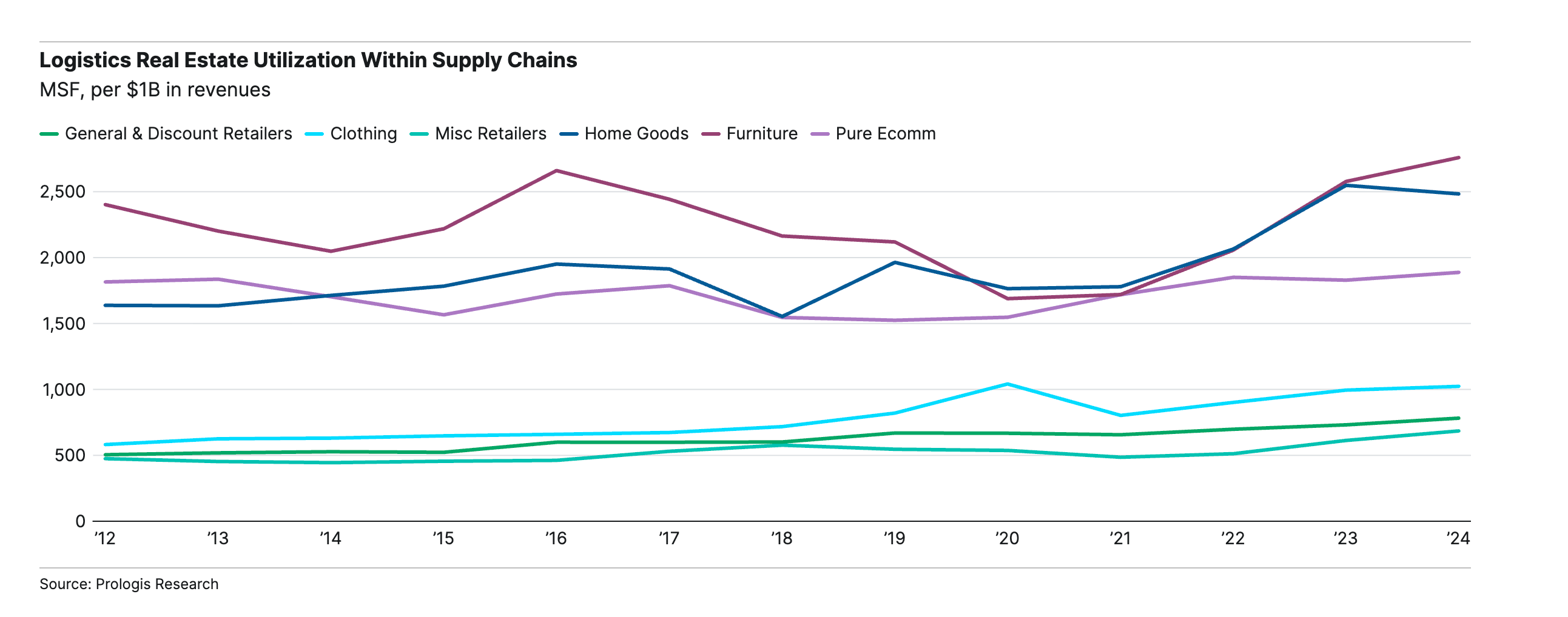
Prologis estimates that in 2025, 40% of built-to-suit logistics projects incorporated automation. That suggests we are gradually moving from warehouses with robots inside them to warehouses designed around automation from day one.
Aldi’s Western Sydney development makes this tangible. The A$1 billion facility will operate 24/7, with around 80% of its operations automated, while sitting directly beside the new Western Sydney Airport.
The obvious conclusion is probably wrong
When I first started looking into this, my assumption was fairly simple.
If we are creating a new generation of warehouses designed around robots, surely a lot of today’s warehouses eventually become obsolete.
The evidence doesn’t really support that. At least not yet.
Prologis’ latest research finds that the most rigid form of warehouse automation, fixed automated storage and retrieval systems, is still present in only around 3–5% of warehouses. The technologies spreading more quickly are flexible systems such as autonomous mobile robots and automated guided vehicles, partly because they can work inside leased buildings without forcing the occupier to redesign the entire property.
Amazon makes the same point from the operator side. Its latest robotic systems were deliberately engineered not only for futuristic new fulfilment centres but for integration across its existing buildings as well.
Humanoid robots could push this even further. GXO’s commercial deployment of Agility Robotics’ Digit has the robots working inside an existing warehouse alongside other automated systems rather than requiring an entirely new robot-specific property.
Locus is pursuing a similar philosophy. Its new Array system is designed to increase automation density in both brownfield and greenfield warehouses without redesigning existing workflows.
So I don’t think the biggest story is that millions of old warehouses suddenly become unusable.
The more interesting possibility is that robotics changes the hierarchy of what makes one warehouse worth more than another.
Automation is already showing up in the rent
There are early signs that this isn’t just about operational efficiency.
Prologis analysed leasing behaviour across its portfolio and found that automated occupiers had a double-digit higher likelihood of renewing, signed leases roughly one year longer and paid rents around 10% higher than non-automated facilities after controlling for market and building size.
That does not mean putting a few robots into a shed magically increases its value by 10%. There is an obvious selection issue: bigger and better-capitalised tenants are more likely to automate, and better buildings are more likely to attract those tenants in the first place.
But the mechanism makes sense.
Once an occupier installs millions of dollars of robotics, software and automated infrastructure inside a building, moving becomes harder. The warehouse is no longer simply rented floor area. It starts becoming part of the tenant’s operating system.
That can mean more capital invested into the asset, longer leases and greater tenant stickiness.
From a landlord’s perspective, that starts to look quite attractive.
But not every warehouse can take the robots
The retrofit story has limits.
Flexible mobile robots can work across a surprisingly wide range of buildings. More advanced fixed automation cannot.
Prologis estimates that sophisticated automated storage and retrieval systems can require up to 20 times more power capacity than other forms of warehouse automation. They can also require high clear heights, enhanced floor loads, jointless floors, wide column spacing, advanced IT infrastructure and climate control.
Suddenly, the industrial investment checklist gets longer. A building capable of serving increasingly automated occupiers may need:
enough electrical capacity, with the ability to secure more;
floors capable of supporting and accurately guiding automation;
suitable clear heights and column spacing;
strong digital connectivity and IT infrastructure;
layouts flexible enough to accommodate systems that may not exist yet;
enough physical adaptability to avoid being locked into one generation of technology.
CBRE’s occupier research suggests this shift is already creeping into property selection. It found that building design, power supply and sustainability have all increased materially in importance to logistics occupiers.
This starts to look similar to what has happened in offices.
For a long time, an office was an office. Then tenants became much more demanding around floorplates, amenities, sustainability, technology and location. A widening gap emerged between buildings occupiers actively wanted and buildings that were still technically offices but increasingly struggled to compete.
Warehouses may be heading towards their own version of that divide.
Not automated warehouse versus useless warehouse.
More subtly: a warehouse capable of accommodating the next generation of occupiers versus one that can’t do so economically.
The bigger question is location
This is the part I find most interesting.
Warehouse location has always involved competing constraints. You want access to customers, motorways, ports and transport infrastructure, but you also need enough people nearby to operate the building.
Automation changes the second half of that equation.
It doesn’t eliminate labour. EY’s latest work on autonomous warehouses found that most organisations are still pursuing hybrid operations combining people and robots rather than genuinely people-free facilities.
But you don’t need to remove every worker for the economics to move.
A warehouse that requires 300 people rather than 1,000 has a very different labour constraint.
That could allow occupiers to put greater weight on proximity to consumers, transport infrastructure, power and the ability to push more goods through a scarce site. In dense markets, that may actually make the best locations more valuable, not less.
Prologis is already seeing something like this in the Netherlands. More than 25% of the space in its Dutch portfolio is automated, including 9% with fixed automation. Its argument is that high land values, limited space and scarce labour encourage companies to automate so they can produce more throughput from existing infill locations.
That’s an important distinction.
A robot warehouse does not necessarily belong in the middle of nowhere because robots don’t need to commute.
A retailer still wants to be close to its customers. A logistics company still wants the motorway. A distributor still wants to minimise how far its goods travel.
Automation can simply remove one of the reasons not to choose an otherwise excellent location.
Power could become the new labour constraint
There is another shift worth watching.
As the requirement for people falls, the requirement for infrastructure rises.
Highly automated warehouses need electricity for robotics and charging, but also sensors, conveyors, IT systems and increasingly sophisticated orchestration software. Add the electrification of truck and van fleets and the grid connection starts to matter even more.
Warehouses obviously aren’t becoming data centres. But the direction is similar: more of the economics of the building become tied to infrastructure that historically sat in the background.
In the old warehouse model, a developer worried about whether there were enough workers nearby. In the next one, they may worry just as much about whether there is enough power.
We’re not yet at the point where a logistics investor should value every warehouse based on available megawatts. The adoption data doesn’t justify that conclusion.
But if I were buying a building I expected to remain institutional quality for the next 15 or 20 years, I would absolutely want to understand its power connection and how easily it could be expanded.
Don’t build a warehouse for today’s robot
There is one final contradiction.
If robotics technology is changing incredibly quickly, designing a building too specifically around today’s robots could actually be the wrong strategy.
The real estate might last 40 years. The robots won’t.
Gartner therefore recommends that companies favour scalable, software-defined robotic platforms over single-purpose automation specifically to improve adaptability and reduce obsolescence risk.
The economics support that. Prologis estimates modular automation requires roughly one-third of the capital of fully automated systems while delivering approximately 1.5 times more throughput improvement per dollar invested.
Perhaps, then, the best warehouse for the robot age isn’t some highly specialised futuristic building.
It might simply be a very good, very flexible box: strong floors, good height, enough power, excellent connectivity, strong transport access and a layout capable of changing several times over its life.
That is a much less exciting vision of the future.
But it is probably a more useful one if you’re buying the real estate.
The $2 trillion question
Ares describes global industrial real estate as an approximately $2 trillion sector. Much of that value sits in warehouses expected to remain standing long after today’s generation of robots has disappeared.
I don’t think robotics is about to make those buildings obsolete.
For the better assets, the early evidence suggests it could do the opposite. Automation allows occupiers to process more goods through the same footprint, can involve significant tenant capital investment and is already associated with longer leases, higher renewal rates and higher rents.
But it also introduces another layer into industrial underwriting.
Five years ago, I might have asked whether a warehouse had enough parking and sat within a deep enough labour pool to recruit 500 employees.
Increasingly, I would also want to know how easily it can be automated. Whether its floors, column grid and clear height constrain future systems. Whether its power connection can expand. Whether a future tenant can install new technology without effectively rebuilding the property.
And perhaps most interestingly, whether I am paying a premium for a location advantage that only exists because warehouses currently need large numbers of people.
The warehouse of 2035 may not look particularly futuristic from the outside.
It could still be a very big box beside a motorway.
The thing that changes may be why that box is valuable.
Thanks for reading. Make sure to subscribe if you want this in your inbox every week.