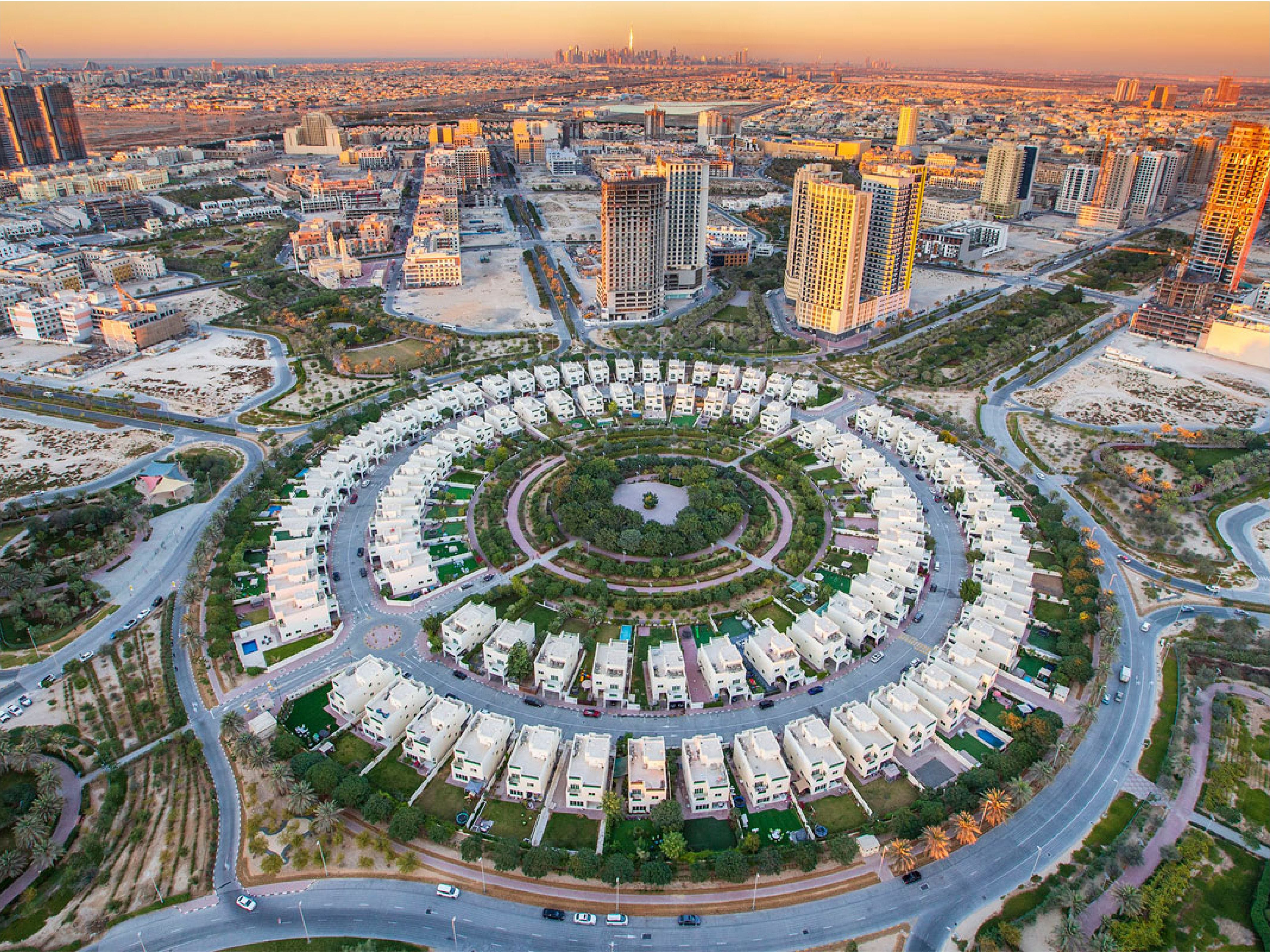
Off-plan heavy markets don't lack apartments. They lack apartments institutions can buy.
A Dubai case study
A city that sold 147,500 homes last year still can’t sell you an apartment block. That gap is the most interesting underwriting problem in residential real estate right now - and it isn’t only a Dubai problem.
In May, Abu Dhabi’s largest listed developer committed AED 1.1 billion - roughly $300 million - to a residential community that does not exist.
Aldar bought six mid-rise buildings, 312 homes, a community mall and a park from a private developer called SRG in Dubai Studio City. Completion is scheduled for 2028. It will not collect a dirham of rent for around two years, and it agreed the price before a single unit was leased or, in any meaningful sense, finished.
Now hold that against the market it happened in. If you want to own residential property in Dubai, it is close to the easiest thing in the world to do. There are brokers in forty countries who will sell you one before lunch.
So why does a sophisticated institutional buyer commit $300 million to a building two years before it exists, in one of the most liquid housing markets on earth?
Because it can’t buy one that already does.
That is the argument of this piece. Dubai has spent two decades perfecting the capital market for the individual apartment and has barely started building one for the apartment building. The binding constraint on institutional residential here is not capital, and it is not demand. It is product. And if you underwrite deals in Manchester, Madrid, Mumbai or Miami, the diagnostic travels further than you’d think.
Today’s Brief:
Why 147,500 home sales don’t add up to one investable market
Two kinds of liquidity, and why underwriters keep conflating them
What the institutional bid actually is (hint: it isn’t GDV minus ten percent)
The 6.6% that isn’t a yield
The exit almost nobody prices
Two Kinds of Liquidity
Dubai’s rental economy is not small. DLD registered 1.38 million tenancy contracts worth AED 126.4 billion in 2025, with value up 17% year on year. There is more than enough occupier demand to support institutional rental platforms.
What’s thin is the market for the assets themselves.
Search a decade of UAE transactions and you find precedents, not a tape. Arcapita bought 285 Saadiyat apartments in 2015. A dedicated residential REIT assembled Abu Dhabi portfolios in 2017–18. An Omani fund bought two entire Binghatti buildings in 2018. In December 2025, Nisus Finance’s DIFC fund acquired Lootah Avenue, a fully occupied 273-unit tower in Motor City, for an all-in AED 221 million.
Dozens of deals. Not hundreds. In a city that transacts homes six figures at a time.
This is the distinction that gets missed: transaction liquidity and investment liquidity are not the same thing. Dubai has extraordinary depth at the unit level and very little at the asset level. Headline transaction counts measure the first and tell you nothing about the second.
The mechanism is the off-plan pre-sale, still roughly three-quarters of Dubai residential transactions. A pre-sale doesn’t just finance a building. It atomises it - converting one future asset into hundreds of separately titled ones, held by hundreds of owners across dozens of jurisdictions, before the foundations are poured. And it’s close to irreversible: reassembling a strata building requires near-unanimity from a shifting cast of owners with different bases, tax positions and appetite to sell. In practice, nobody does it.
What to learn: every off-plan launch is a permanent decision about which market that building will live in for the rest of its life. Most developers don’t experience it as a decision at all.
The Institutional Bid Is Not GDV Minus Ten Percent
The folk model of institutional buying is that a fund turns up, takes 300 units off your hands and demands a bulk discount - 10%, 20%, whichever number the brokerage marketing page happens to use. I could find no credible primary or adviser dataset supporting any of them.
The framing is wrong at a more basic level. The institutional bid isn’t retail price minus a haircut. It is:
stabilised NOI ÷ required yield, less lease-up, capex and risk allowances, discounted back to the payment dates.
Those two numbers are computed from different inputs and they are only coincidentally related. If the second can’t beat net strata proceeds after commissions, incentives, absorption risk and financing, there is no transaction - regardless of how motivated either party is.
That explains the scarcity better than any story about conservative capital. In a strong off-plan market the developer should sell individually: retail pricing is higher, buyer instalments make the working capital free, and global distribution is already built and paid for.
So the interesting question isn’t why institutions aren’t buying. It’s what has to change for the institutional bid to win. The answer is absorption risk. And 2026 has been busy supplying it. CBRE recorded just under 37,000 Dubai residential sales in Q2 2026, down 29% year on year from more than 51,000. Aldar’s own Q1 group sales fell 25%, which the company attributed to moderating activity and a deliberately disciplined launch programme.
Here’s my take: the forward purchase is being described as a financing innovation when it is closer to a hedge. A developer selling an entire scheme to one covenanted buyer before completion converts a two-year absorption risk into a signed contract. That trade is unattractive at the top of a sales cycle and increasingly attractive on the way down. Expect more of it, and expect it to be framed as strategy after the fact.
The 6.6% That Isn’t a Yield
In the first half of 2026, Dubai Residential REIT added two clusters through forward purchase: 56 villas at Garden View for AED 241 million, and 220 townhouses at Jebel Ali Village for AED 894 million. Combined outlay: AED 1.135 billion. Management expects the two to contribute approximately AED 75 million in incremental revenue once stabilised.
That’s a 6.6% ratio of revenue to acquisition cost.
It is not a 6.6% yield. Out of that AED 75 million still come facilities and property management, common-area costs, utilities, insurance, leasing, bad debt, administration, unit turns, MEP lifecycle and a capex reserve - before a dirham of financing cost.
A unit buyer runs three inputs: price, rent, “yield”. An asset buyer runs a different model entirely - passing rent against ERV, the month-by-month expiry profile, retention, economic vacancy, gross-to-net leakage, a lease-up curve, a capex reserve, and a terminal yield. Two Dubai-specific wrinkles matter here.
First, reversion is regulated. The REIT reported 98% tenant retention in Q1 2026, which is superb for occupancy and awkward for mark-to-market: renewal increases are governed by the permitted-increase framework and notice requirements, not by today’s asking rent. Passing-to-ERV reversion is valuable, but the speed at which you can capture it is not yours to choose.
Second, and more serious: there is no published multifamily cap-rate tape in Dubai. In a European underwriting, exit yield is a contested assumption tested against dozens of comparable trades. Here it is the assumption doing the most work in your model and the one you can least evidence. Widen the sensitivity. Then widen it again.
The Exit Almost Nobody Prices
One asymmetry genuinely favours the institutional owner here, and it gets almost no attention.
Bonyan REIT, a Tadawul-listed fund, owned a 69-unit residential building at City Walk and ran it for rent, collecting SAR 54.9 million of rental income over its hold. Then, from December 2022, it did something that would be legally and politically painful in most European cities: it broke the building up and sold the units individually, realising SAR 279.9 million against a disclosed acquisition cost of SAR 262.5 million.
You can’t derive a return from those headline figures - acquisition date, opex, debt, sales costs and cash-flow timing are all missing. But strategically it’s revealing. An owner with single control of a strata-able building in a freehold zone holds a genuine option: underwrite the NOI, and retain the right to disaggregate into the deepest unit-level buyer pool on the planet.
The real opportunity is this: at identical NOI, a Dubai multifamily asset may be worth more than its European equivalent, because terminal value has two routes rather than one. Almost nobody prices that. It should be priced - as an option with a probability and a cost attached, not as a free upside case. Exercise depends on title structure, physical configuration, sales velocity and timing, and the option is worth least in a soft resale market, which is precisely when you’d want it most.
What Would Have to Be True
I want to be honest about the strength of the evidence, because the case for institutionalisation is thinner than the recent headlines suggest.
Dubai Residential REIT is not proof of a deep third-party acquisition market. It listed in 2025 as the GCC’s largest REIT, 26 times oversubscribed on more than AED 56 billion of demand, and now runs 35,900+ homes at over AED 23.5 billion GAV. But much of that is legacy Dubai Holding stock, and its stated pipeline - Lantana Hills, Dubai Wharf, The Acres - sits inside the same group. That proves public capital will fund residential NOI. It does not prove ten unrelated buyers could source AED 20 billion of stabilised product tomorrow.
I moved to Dubai years ago to raise capital for a UK BTR brand trying to break into the UAE. It was terribly difficult.
So the defensible claim is not “Dubai is becoming a multifamily market.” It’s narrower and, I think, more useful: Dubai is beginning to build a second way of capitalising housing, alongside a vastly larger one that is not going anywhere.
The Bottom Line
Where you sit changes what you do with this.
If you develop: your scheme has two possible buyers, and you choose between them at launch, not when sales stall. Model the wholesale exit before you commit to the strata one. A building designed for 300 individual buyers is not the building an institution wants - unit mix, back-of-house, service specification and title structure all diverge, and retrofitting them later is expensive or impossible.
If you allocate capital: here you will largely have to manufacture what you want to own. That means underwriting forward-development risk - completion dates, developer covenant, defects, handover testing - rather than stabilised acquisition risk. Different skill, different return profile, different committee conversation.
If you lend: you are underwriting an operating business with an occupancy curve, not 300 titles with a rent roll stapled to them.
And if you’re reading this from outside the Gulf: the diagnostic is portable. Every market that industrialised pre-sales - much of the GCC, large parts of Asia and Latin America, and in its own way the UK leasehold flat market - manufactures the same outcome. Enormous unit-level liquidity, negligible asset-level liquidity, and a supply of housing that grows every year while the supply of investable housing barely moves.
So the question to ask of any such market is not how many homes traded last year. It’s how many buildings are still under single control.
A city can record 200,000 housing transactions a year and still have almost no market for apartment buildings. The constraint on institutional residential in Dubai isn’t capital. It’s product - and product is a decision somebody makes at launch, years before any institution gets to bid.
Thanks for reading,
Zakee


