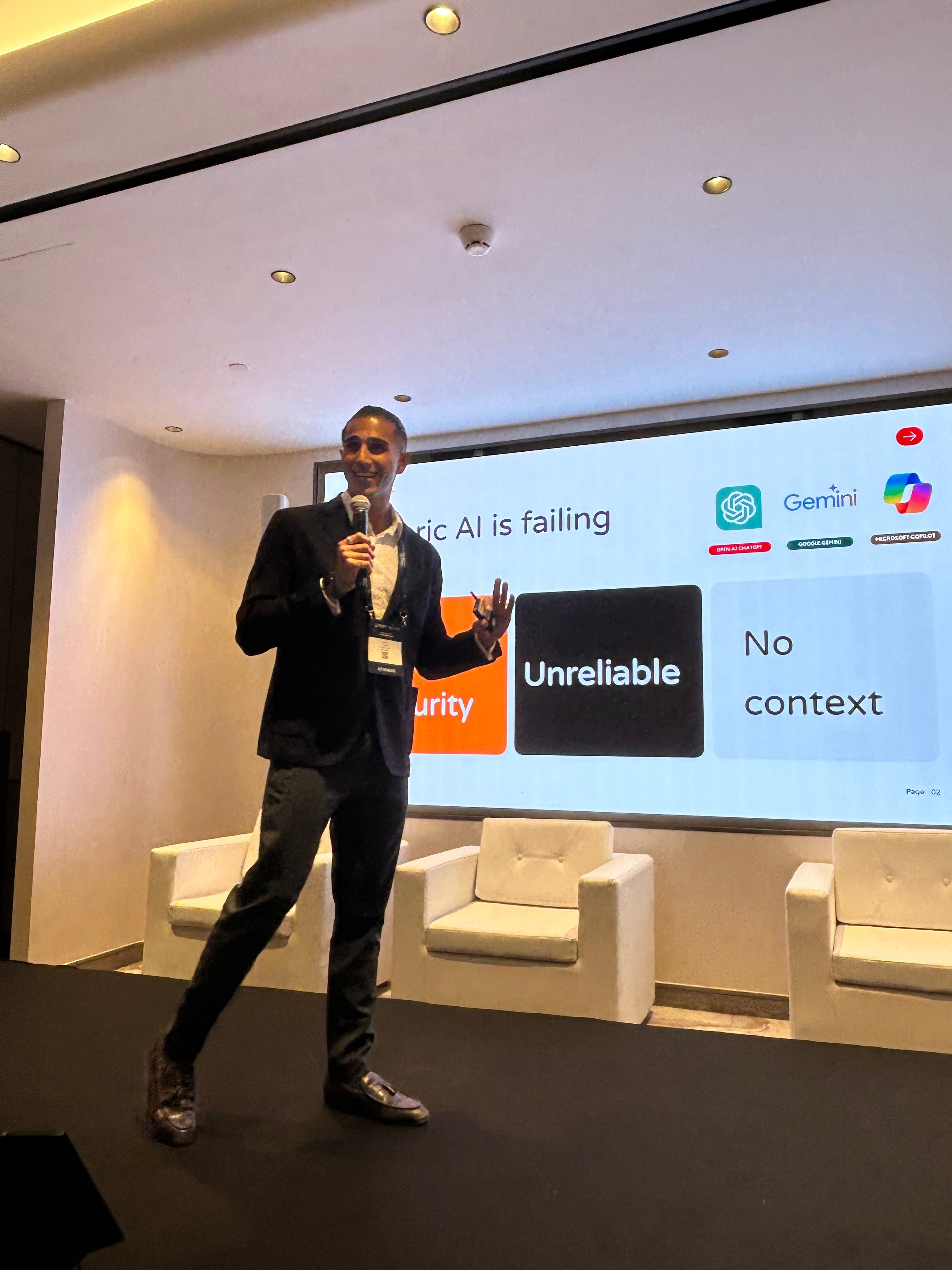
I built an AI research platform for Dubai real estate. Here’s what most firms still get wrong.
Last month, I sat across from a Dubai-based developer - 2,000+ units under development, solid portfolio — and asked a simple question:
“How does your investment team pull comps for a new site acquisition?”
The answer: one analyst, three browser tabs (DLD, PropertyFinder, Bayut), a shared Excel file, and about four days.
They had a ChatGPT Enterprise subscription. They had a BI dashboard nobody used. They had budget for “digital transformation.” What they didn’t have was a single AI tool embedded in an actual workflow that anyone on the team relied on to make decisions.
This is not an unusual story. It’s the default.
After spending the past year building Buildable - an AI-powered platform for investment teams, developers, and consultancies/valuers - I’ve had hundreds of conversations with developers, brokers, investment teams, and asset managers across the Gulf.
The pattern is consistent: firms know AI matters, they’ve bought tools, and almost nobody has changed how they actually work.
The technology isn’t the bottleneck. Implementation is. And that gap - between what AI can do and what real estate teams actually do with it - is now the single biggest competitive differentiator in the industry.
Today’s Brief:
What building Buildable taught me about how real estate professionals actually interact with AI
The five implementation mistakes I see firms making repeatedly
What the firms getting it right look like - and what separates them from everyone else
Why I’m launching an AI consultancy to close the gap directly
What happens next: the 5-year view on AI-native real estate teams
What Building Buildable Taught Me
The original thesis behind Buildable was straightforward: Dubai real estate professionals spend absurd amounts of time on research tasks that AI can do in minutes. Pulling DLD transaction data, building comparable analyses, generating market reports, running feasibility numbers - this is mechanical work that eats 15-20 hours per week for a typical investment analyst or senior broker.
Buildable automates that. You can try it yourself.
But the more interesting thing I learned wasn’t about the product. It was about the people using it.
Lesson 1: Nobody wants “AI.” They want faster answers to specific questions.
Every time I demo Buildable, the reaction is the same. Nobody cares about the model architecture or the data pipeline. They care that a comp report that took four days now takes four minutes. They care that they can walk into an investor meeting with fresher data than the guy across the table.
The implication is important: firms that frame AI adoption as a technology initiative miss the point entirely. It’s a speed-to-decision initiative. The question isn’t “should we use AI?” - it’s “where are we losing time on decisions that should be faster?”
Lesson 2: The data infrastructure problem is worse than the technology problem.
Most firms I speak to don’t have a data problem in the sense of “we don’t have data.” They have a data chaos problem. Transaction records in one system, rent rolls in another, market reports in a shared drive nobody organises, broker intel in WhatsApp groups that disappear after 30 days.
AI is only as good as the data you feed it. When a firm’s institutional knowledge lives in scattered spreadsheets and the heads of three people who’ve been there since 2015, no AI tool - no matter how sophisticated - will deliver reliable outputs. The unsexy first step is almost always: organise what you already have.
Lesson 3: Adoption is a workflow problem, not a training problem.
I’ve watched firms run training sessions, create Slack channels for “AI tips,” and send around LinkedIn posts about prompt engineering. None of it moves the needle. What does move the needle: embedding AI into the exact step where someone currently loses time.
If your analyst pulls comps from DLD every Monday morning, the AI tool needs to live inside that Monday morning workflow - not in a separate app they have to remember to open. The firms that get adoption right don’t add AI on top of existing processes. They redesign the process around AI from the start.
The Five Implementation Mistakes I See Every Firm Making
After dozens of conversations with real estate teams attempting AI adoption, the failure modes are remarkably consistent.
1. Starting with the tool, not the workflow
The most common mistake. A firm hears about a new AI tool - could be a general-purpose LLM, could be a property-specific platform - and buys a subscription. Then they tell the team to “start using it.”
Nobody does. Or worse, a few people use it for random tasks (rewriting emails, generating social posts) while the high-value workflows that actually drive revenue remain untouched.
The fix is obvious but rarely followed: start by mapping the five workflows where your team loses the most time. Then ask which of those are data-heavy, repetitive, and rule-bound. Those are your AI candidates. Buy the tool after you know the workflow, not before.
2. Treating AI as an IT project
In most firms, AI adoption gets assigned to the technology team or an “innovation lead.” This is a structural error. AI implementation in real estate is an operations problem, not a technology problem.
The people who need to lead adoption are the ones closest to the work: the head of acquisitions, the head of leasing, the research director. They understand where time gets lost, where decisions stall, and where better data would change outcomes. IT should support the infrastructure. Operations should own the strategy.
3. Expecting magic from generic tools
ChatGPT is extraordinarily capable. It’s also trained on the general internet, not on your market, your portfolio, or your deal pipeline. When a Dubai investment team asks ChatGPT for comparable transactions in JVC, the output is, at best, directionally useful and, at worst, confidently wrong.
The firms making progress distinguish between general AI (useful for drafting, summarising, brainstorming) and domain-specific AI (trained on or connected to real estate data sources). You need both, but confusing them leads to disappointment and, more dangerously, to bad decisions based on plausible-sounding but inaccurate outputs.
This is exactly why we built Buildable with live DLD transaction data and Dubai-specific market intelligence rather than relying on general-purpose models alone.
4. No feedback loop
A firm deploys an AI tool, gets initial results, and moves on. Six months later, nobody’s using it, and the firm concludes that “AI doesn’t work for our business.”
What actually happened: the tool produced decent first-pass outputs, but nobody iterated. Nobody said “this comp report is 80% right but misses off-plan payment plan adjustments” and then worked with the tool (or the vendor) to fix that 20%. AI implementation is iterative. The first deployment is the starting line, not the finish line.
5. Ignoring the “last mile”
AI produces outputs. Humans make decisions. The handoff between the two is where most implementations quietly fail.
An AI tool generates a market report. Now what? Does it go into the investment committee deck as-is? Does an analyst review and adjust it? Does a senior partner add qualitative context? If this isn’t designed - if there’s no clear “AI generates, human validates, decision gets made” workflow - then the AI output sits in a folder and the team defaults to doing things the old way.
The firms that succeed build explicit handoff protocols: AI does the data-heavy first pass, humans add judgment and context, and the combined output is what drives the decision. Neither alone is sufficient.
What the Firms Getting It Right Actually Look Like
Not every firm is stuck. A minority - maybe 10-15% of the ones I speak to - are pulling ahead. And the gap is widening.
JLL’s in-house “JLL GPT” is the most cited example. They turned a partnership memorandum that used to crawl through 4-6 weeks of back-and-forth into a first draft in under five hours. That’s a 40x speed-up on a single workflow. But the real insight isn’t the speed - it’s that JLL started with a specific, painful, high-value workflow and built a custom solution around it.
A 2024 Delta Media survey found that 75% of leading brokerages report firm-wide AI usage and 82% of their agents use it daily. But dig into the numbers and most of that usage is for property descriptions and social media posts - the low-value, low-risk end of the spectrum. The firms pulling ahead are using AI for the high-value work: underwriting, market analysis, investor reporting, deal screening.
What separates the winners:
They started with one workflow. Not a grand “AI transformation strategy.” One specific process where the team was losing time. They fixed that, proved the ROI, then expanded.
They embedded AI into existing tools. The successful implementations I’ve seen don’t ask people to learn new platforms. They bring AI into the tools teams already use - their CRM, their Excel models, their reporting templates. The less behaviour change required, the higher the adoption.
They measure time saved, not “AI usage.” Vanity metrics like “number of prompts” or “percentage of team with accounts” are meaningless. The metric that matters: how many hours per week did this workflow take before, and how many does it take now? If you can’t answer that, you don’t know if your AI investment is working.
They have an internal champion who isn’t from IT. In every firm I’ve seen succeed, there’s one person - usually in operations, research, or investment - who understood the potential, ran the pilot, and evangelised internally based on results. AI adoption is a people problem first.
Why I’m Launching an AI Consultancy
Building Buildable solved one piece of the puzzle: giving real estate professionals AI-powered research and data analysis purpose-built for their market. But the conversations I keep having go further.
“Can you help us automate our investor reporting?”
“We need something like Buildable but for our lease abstraction process.”
“Our team spends 20 hours a week on [specific workflow]. Can AI fix this?”
The answer to all of these is yes - but not with a single product. Every firm’s workflows, data, and pain points are different. What they need isn’t another SaaS subscription. They need someone who understands both the AI and the real estate to come in, identify the highest-leverage opportunities, and actually build and implement the solutions.
That’s what I’m now doing.
Lemon Consulting works directly with real estate businesses - developers, investment firms, brokerages, asset managers - to:
Audit existing workflows and identify where AI creates the highest ROI (not every workflow is worth automating)
Design and build custom AI solutions tailored to your specific data, processes, and team
Implement and iterate — not hand over a strategy deck, but actually deploy the tools, train the team, and optimise based on real usage
Build internal AI capability so your team can maintain and extend what we build together
This isn’t consulting in the traditional sense. There are no 80-page strategy decks. No “digital transformation roadmap” that gathers dust. It’s hands-on implementation: we build the thing, embed it in your workflow, and measure whether it actually saves time and improves decisions.
If you’re a real estate firm that knows AI should be changing how you work but hasn’t figured out how to make it stick, drop me a DM on LinkedIn.
What Happens Next: The 5-Year View
The real estate firms that win the next five years won’t be the ones with the best AI tools. They’ll be the ones that implemented AI into their actual decision-making workflows first.
This isn’t speculation. We’re already seeing the divergence.
In PwC’s 2025 Emerging Trends in Real Estate pulse, investors using predictive analytics reported approximately 15% higher returns on value-add deals versus peers who didn’t. That gap will widen as AI tools improve and early adopters compound their advantage.
Within three years, I expect the following to be standard at any serious real estate firm:
AI-generated first drafts of investment memos, market reports, and comparable analyses - with human review and sign-off, not human creation from scratch.
Real-time portfolio monitoring where AI flags underperformance, maintenance risks, and refinancing windows before a human notices them.
Dynamic pricing and revenue management that adjusts rental rates and sales strategies based on live market data - not quarterly reviews of stale benchmarks.
Automated regulatory and compliance tracking across markets, especially critical for firms operating across the GCC where regulations differ between Dubai, Abu Dhabi, Riyadh, and Jeddah.
The firms that build these capabilities now will have an insurmountable data and process advantage by 2028. They’ll underwrite faster, price better, and operate more efficiently than competitors still running on spreadsheets and instinct.
The firms that wait will find themselves competing against organisations that make better decisions, faster, at lower cost. That’s not a technology gap. It’s a survival gap.
The Bottom Line
The AI implementation gap in real estate is the single biggest under-discussed competitive dynamic in the industry right now.
The technology exists. General-purpose AI is powerful and getting cheaper. Domain-specific tools like Buildable are making institutional-grade research accessible to firms of every size. Custom AI workflows can be built and deployed in weeks, not years.
What’s missing is implementation: the unglamorous work of mapping workflows, embedding tools, training teams, building feedback loops, and iterating until AI is genuinely part of how decisions get made.
That’s the gap I built Buildable to address on the research side. And it’s the gap I’m now closing directly through Lemon Consulting on the operational side.
If you’re a Dubai real estate professional or team and you want AI-powered research and market intelligence, start a 7-day Buildable trial or book a demo.
The window for first-mover advantage is open. It won’t stay open for long.
Until next time, Zakee


