

A few years ago I moved to Dubai to raise capital for a UK Build-to-Rent developer-operator.
I spent 6 intense months sitting across the table from institutional investors, family offices, and developers. But I kept hitting the same brick wall.
Not scepticism about the product. Something more basic.
There were almost no benchmarks. Few comparables you could trust. No clean way to answer the question every serious allocator asks: what does this asset actually earn, and how do I know?
In the US or UK, that question has an answer. Years of standardised reporting, performance data, and stabilised transactions sit behind it. In Dubai, I was often reconstructing it from scratch, deal by deal. Or trying to show how a UK scenario would play out in the Gulf.
This is the way I see it:
The demand was always there. Tenants existed. Occupancy was high. What didn’t exist was a reason for a developer to own a whole building for rent when they could sell it unit by unit for more, and the case studies to prove otherwise.
BUT. This is now changing.
Dubai’s residential market cooled in the second quarter of 2026. Savills recorded 35,884 residential transactions, down 19% quarter on quarter, and framed it carefully as normalisation, not a broad-based correction.
Considering how much the market grow over the past 12 months, a “slow-down” is not as negative as it sounds. In fact, for build-to-rent, it may be a good thing.
A softer sales market doesn’t kill institutional rental. It creates the conditions under which it finally becomes buildable.
Today’s Brief:
Why Dubai proved the rental demand but never the rental development equation
The basis problem: why condo sell-out beats capitalised rent
What actually changed in Q2 2026
The UK playbook, and why the same mechanism is now visible in the Gulf
How institutional rental is quietly being assembled, one acquisition at a time
Why this is an opening, not yet a sector
Upgrade to Real Brief Pro and you get:
The full investor database - 2,000+ family offices, real estate companies, developers, and capital sources you can use directly for outreach, partnerships, and deal flow.
An AI opportunity review - a practical review of where AI could save time, sharpen your analysis, or create leverage in your real estate business.
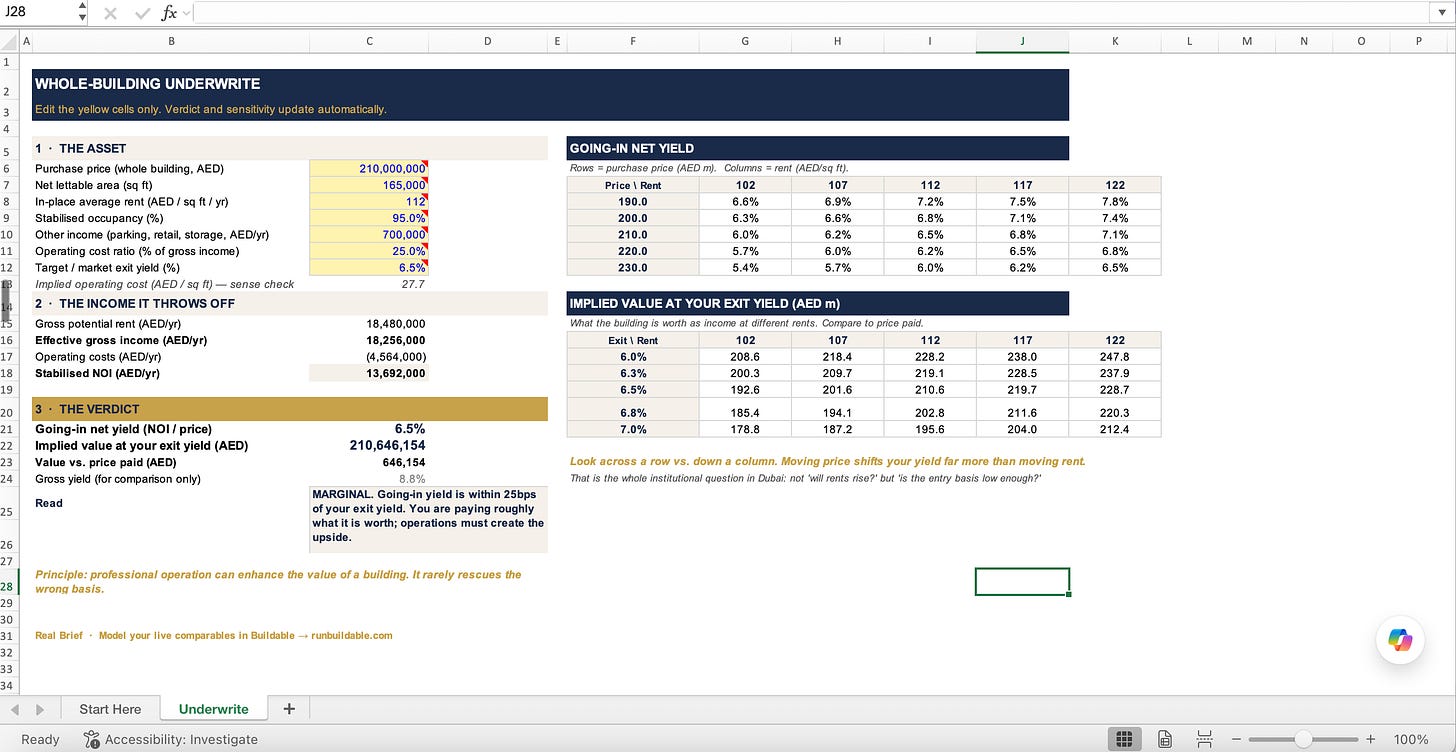
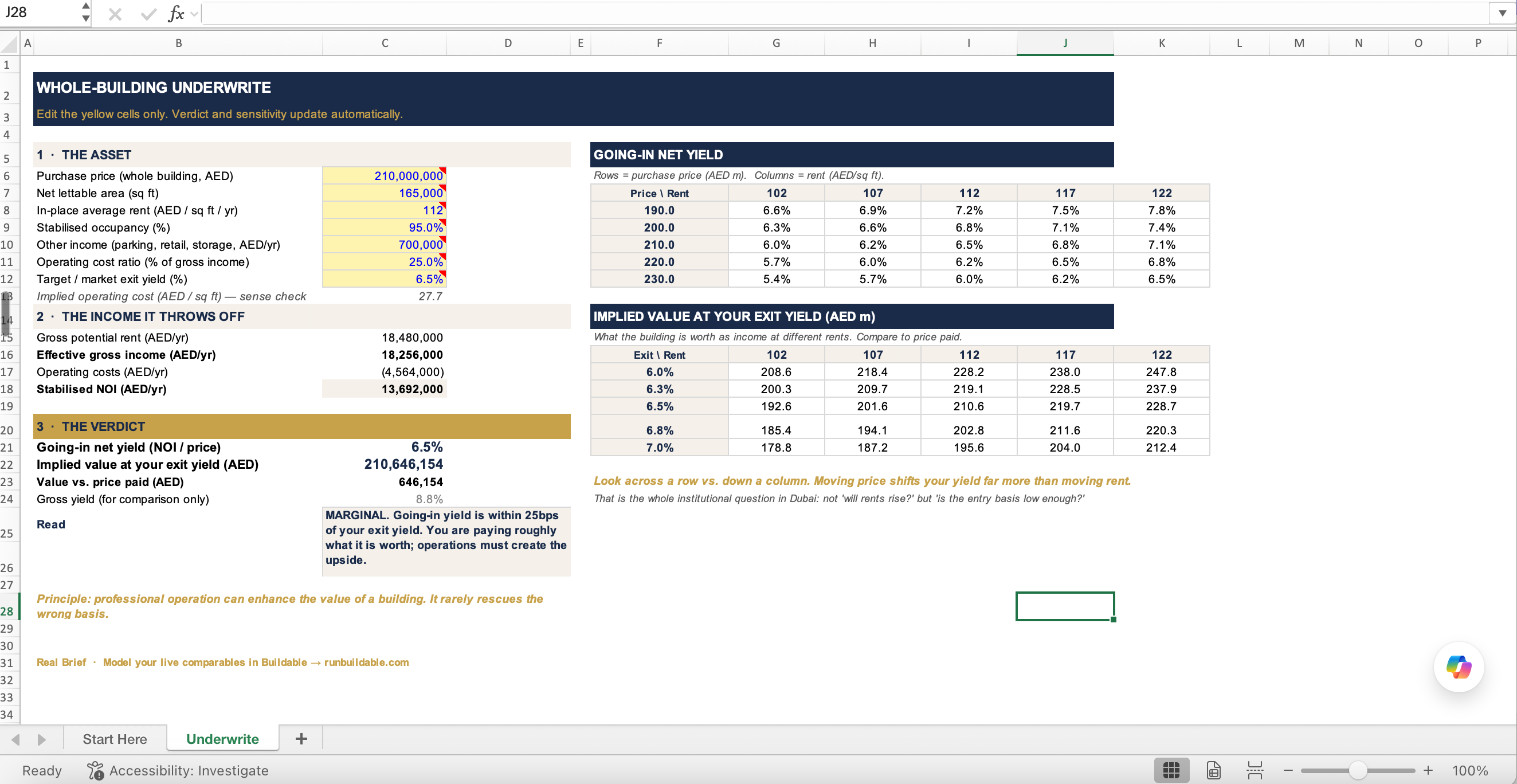
Our BTR quick underwriting model. Enter a price, rent, and service charge; get your net yield, implied value, and a verdict on the basis.
This can all be yours on the 7-day free trial. Use the link at the bottom of this article to grab the trial.
The demand was never the problem
Dubai has proven, at scale, that professionally managed rental housing works here.
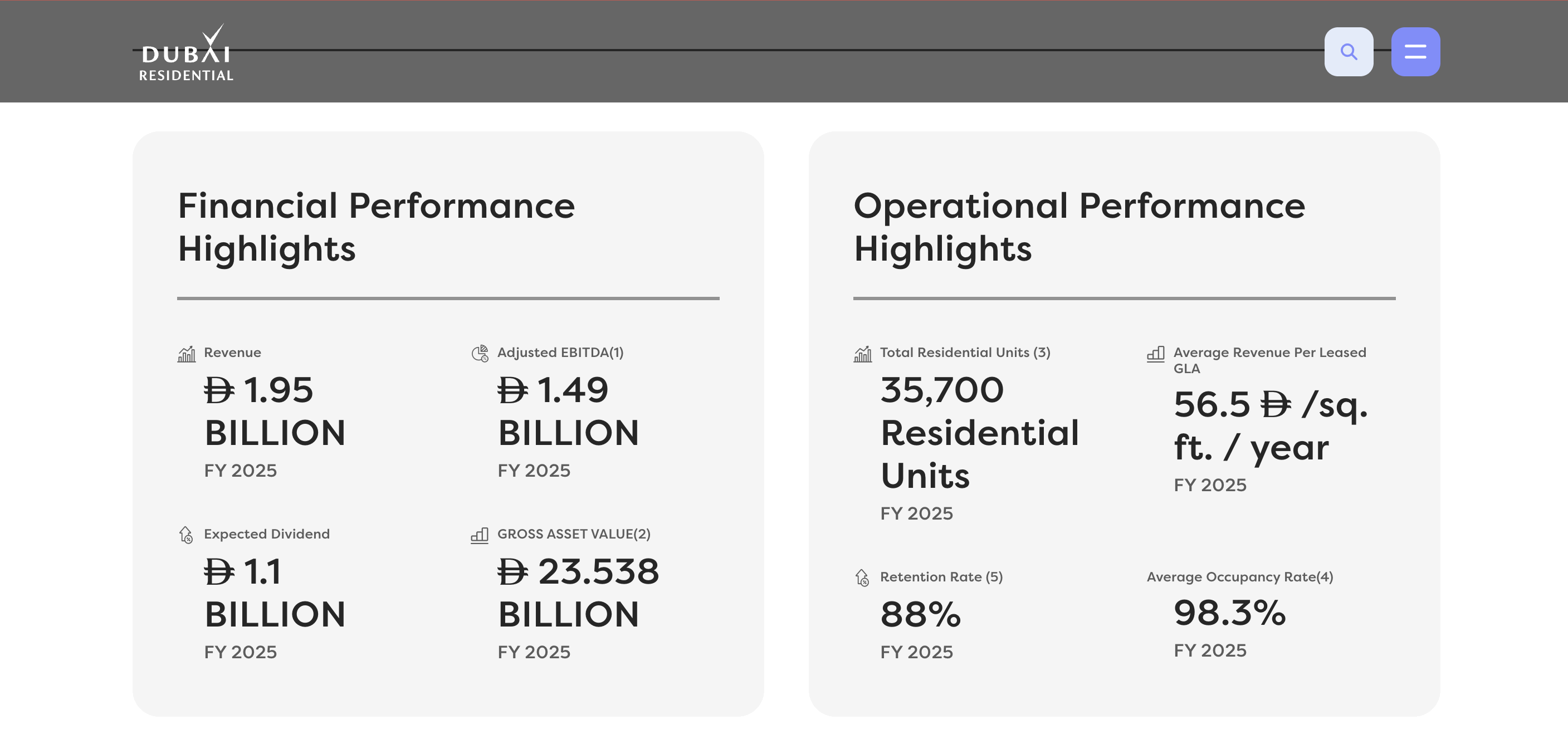
Dubai Residential REIT is one of the largest residential owners in the emirate. It ran at 98.9% portfolio occupancy in Q1 2026, with revenue per leased GLA up 7.4% year on year.
These are the numbers of a market where the operating model is understood and the income is sticky.
So the constraint on institutional rental in Dubai has never been demand.
It has been basis. The price you pay to own the asset.
The basis problem
A build-to-sell developer values land off the sum of individual unit sale prices. Take those prices, subtract construction, financing, marketing, and profit. If retail prices are running ahead of rents, the developer can justify paying a lot for land. The exit is driven by what the strongest individual buyer will pay per unit.
A build-to-rent investor values the same land differently. They look at the stabilised net operating income of the finished building, then capitalise it at the yield they require. The asset is worth its rent roll divided by that yield. Nothing more.
When sale values run well ahead of capitalised rental values, those two worlds drift apart.
The land price that unit sell-out can support simply collapses under a rental underwrite. Again, to re-iterate, there is no lack of demand for build-to-rent. It is blocked by the fact that someone selling apartments individually can pay more for the same site.
This is why Dubai has been a superb place to sell homes and a hard place to own buildings for income.
So the interesting question isn’t “will rents rise?” It’s this: will the spread between sale value and income value narrow enough that a seller prefers certainty and speed over the last slice of theoretical unit revenue?
What actually changed in Q2 2026
Three things shifted at once. Together, they move that spread.
First, sales absorption weakened. And it weakened most in the ready and resale market rather than off-plan. That matters, because resale is where price discovery happens fastest.
Second, developers slowed launches sharply while deliveries surged. Roughly 27,300 homes were handed over in Q2 2026, the highest quarterly delivery volume in recent years. More completed stock means more choice, weaker scarcity pricing, and more leverage for anyone negotiating for a whole building rather than a single flat.
Third, and most telling, owners started choosing to refinance rather than sell. Refinancing rose to around 70% of Savills’ valuation instructions by the end of Q2, against a historical norm closer to 30%.
This is now a market where sellers are reluctant, buyers are selective, and the straight-line pricing of the boom has been replaced by something more negotiable.
None of this is distress. Q1 2026 was still strong. Trophy deals still cleared. The IMF characterised UAE real estate as having simply moderated in the first half of 2026, with prices broadly at or above 2025 levels.
But, this market ‘normalisation’ is what we need for developers to have appetite to include BTR (build-to-rent) in their pipeline.
The UK already ran this play

If this mechanism sounds abstract, look at what just happened in Britain.
The UK build-to-rent sector didn’t emerge because developers suddenly discovered people need homes. It emerged because retail sales absorption weakened, and institutions became a useful alternative buyer.
When mortgage affordability tightened and private sales slowed, housebuilders started selling homes in bulk to institutional owners instead of one buyer at a time.
An article yesterday from the FT reported that 12% of London homes initially marketed for private sale were sold in bulk in the year to 30 June 2026, up from 7% a year earlier, with bulk-buyer discounts rising to 15-20%.
This is a real case study of what could happen in Dubai:
Retail demand softens
Carrying costs bite
Developers trade a slice of price for certainty and speed
Institutions provide the exit
The forward-purchase model that carried UK build-to-rent to scale is the same one now surfacing in the Gulf. Legal & General, Long Harbour, and Lloyds Living have all grown by funding or buying homes directly from housebuilders, rather than developing towers from the ground up.
The US tells a sharper, more cautionary version. American institutional single-family rental was born from genuine distress. After 2008, foreclosure-driven cheap stock let operators aggregate homes at extraordinary discounts. Invitation Homes and American Homes 4 Rent each now own tens of thousands of houses.
The lesson from the US isn’t that Dubai faces a similar crisis. It doesn’t. The lesson is narrower and more useful: when acquisition basis dislocates enough, an entire rental asset class can be assembled surprisingly fast, as long as operating systems and financing are in place.
So the pattern holds across three very different markets. Rental sectors don’t scale when demand appears. They scale when the price of owning the asset finally makes sense.
Institutional rental is being bought, not built
Now watch what’s actually happening in Dubai, rather than what the sector is supposed to look like.
In May 2026, Aldar acquired a 312-home residential-for-rent community in Dubai Studio City from a private developer for AED 1.1 billion, explicitly to expand its recurring-income rental platform in the city.
This is the signal I get from this: a state-of-the-art developer range the numbers on selling unit by unit, and CHOSE the certainty of a single sale instead.
Dubai Residential REIT is doing the same thing through its pipeline. It’s taking down family housing in bulk where a single operator can run the whole community, adding 56 villas at Garden View Villas and 220 townhouses at Jebel Ali Village through forward purchase.
Is it a pattern?
Maybe. Maybe not.
But one thing seems clear to me. Dubai’s biggest players are building rental platforms NOT as purpose-built towers erected in opposition to the sales market. They’re being assembled out of the sales market. Forward purchases. Whole-building acquisitions. Related-party pipeline transfers. Bulk buys.
The next institutional rental portfolio in Dubai will probably look less like a ground-up development and more like a portfolio quietly aggregated from somebody else’s sales pipeline.
Aldar’s own commentary on an earlier Abu Dhabi bulk sale made the logic explicit. The discount was minor once you accounted for the sales and marketing costs and broker commissions the developer avoided. And the buyer intended to rent the asset before eventually selling.
That’s the whole thesis in one deal. A developer doesn’t need to love a discount for bulk sales to work. They only need to value certainty more than the last slice of theoretical revenue.
Why price matters more than rent
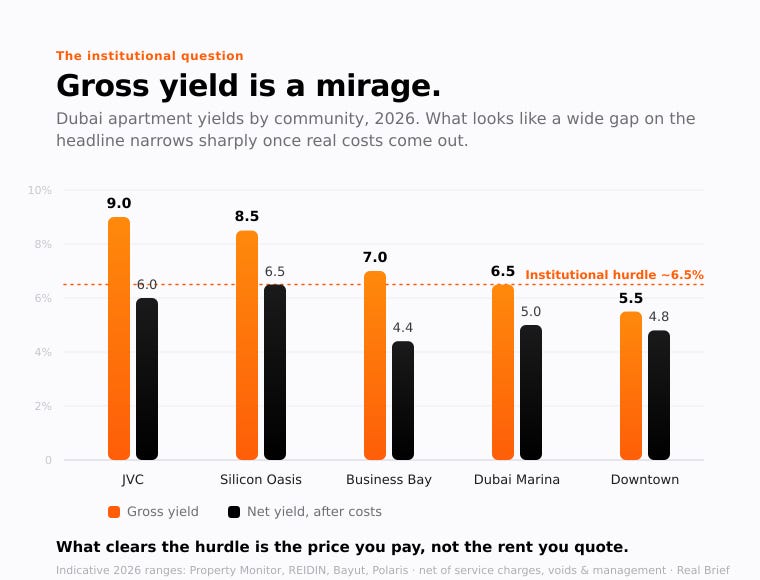
There’s a subtlety here that separates a disciplined underwrite from a hopeful one.
Dubai’s gross yields can look attractive on paper. But gross yield is not the institutional question. Net yield is, after service-charge leakage, leasing costs, and vacancy.
And net yield is far more sensitive to what you pay than to what you charge.
Run the arithmetic on any completed building and you see the same story. A modest change in entry price moves the going-in yield more than a modest change in rent does.
This is why the credible Dubai acquirers have anchored their case on basis. The interesting buildings are interesting because they were bought below prevailing retail evidence, not because someone assumed heroic rent growth.
Professional operation can enhance the value of a building. It rarely rescues the wrong basis.
That distinction is exactly where the work is. Whether a specific acquisition or forward purchase clears an institutional hurdle depends on grinding through real comparable evidence, real service charges, achievable rents per community, and delivery pipeline by submarket. Not a headline gross yield.
This is the exact problem I couldn’t solve cleanly when I first arrived in Dubai, and the reason I built Buildable. It uses AI to compress DLD transaction analysis, comparable evidence, and community-level supply into something you can actually underwrite against in an afternoon, instead of a week per asset.
The honest limits of the thesis
The slowdown is real, but partly shaped by regional geopolitics and reporting lags. Savills itself warned that delayed developer registrations likely flattered the primary market. Some of the Q2 softening may reverse.
And in many cases a Dubai developer can still do better selling units individually. That’s exactly why the institutional route has been slow. Institutions will remain selective, not a wall of capital. The earliest wins may cluster in villas, townhouses, and managed communities rather than isolated apartment towers.
So case for more BTR is narrow, right now. Dubai doesn’t need a crash for institutional rental to arrive. It needs the spread between unit sell-out value and whole-building investment value to compress enough that certainty starts to beat maximisation.
Q2 2026 nudged that spread. It did not close it.
The view from here
The mature version of this story, five to ten years out, is a Dubai where a meaningful slice of rental stock sits inside professionally operated institutional portfolios. Standardised reporting. Benchmarkable performance. Secondary trading in stabilised assets.
That’s roughly the arc the UK travelled. And the mechanism that carried it there is the same one now visible in Dubai. When retail absorption softens and carrying costs bite, institutions become the alternative exit, and the discount required to transact widens just enough to make income underwriting work.
For developers, the lesson is to start treating institutional capital as a real exit option, not a fallback.
For investors, it’s to underwrite basis obsessively and distrust gross yield.
For anyone raising or deploying capital into this, the edge is in seeing which submarkets are repricing, which sellers are becoming negotiable, and which whole-building bases are quietly clearing the hurdle before it’s obvious to everyone.
The city’s rental problem was never a shortage of tenants. It was that land had been priced for build to sell margins, not income returns.
Thanks for reading,
Zakee
Go deeper with Real Brief Pro
The moment a market turns negotiable is the moment underwriting stops being a formality and becomes an edge. When I was raising for build to rent in the UAE, the hardest part was finding the right capital and the data to speak its language. Pro is built to remove both bottlenecks.
Upgrade to Real Brief Pro and you get:
The full investor database - 2,000+ family offices, real estate companies, developers, and capital sources you can use directly for outreach, partnerships, and deal flow.
An AI opportunity review - a practical review of where AI could save time, sharpen your analysis, or create leverage in your real estate business.
Our BTR quick underwriting model. Enter a price, rent, and service charge; get your net yield, implied value, and a verdict on the basis.
Download the underwriting model with the link below:
