

First, some background
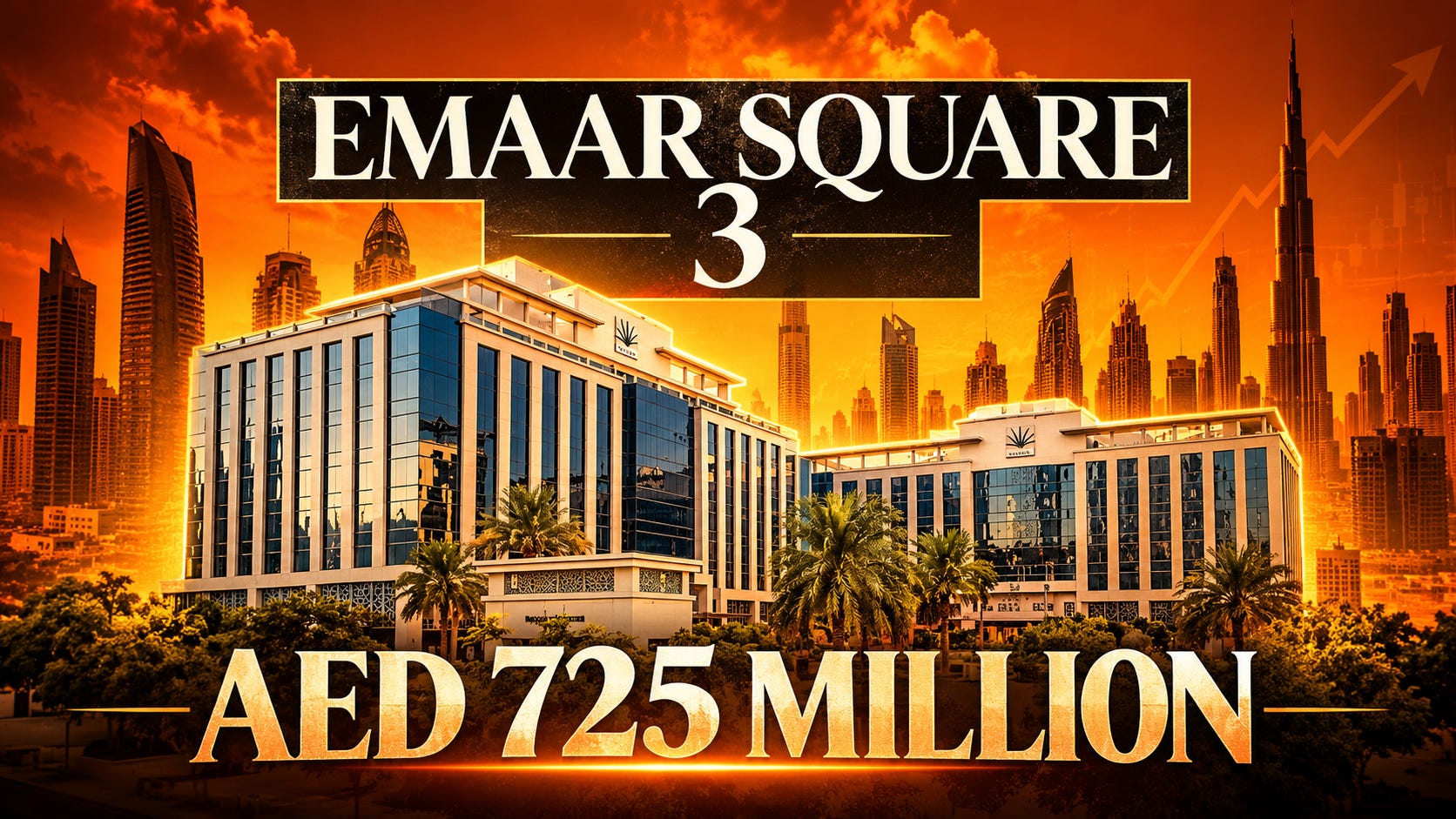
Downtown Dubai is the city’s best-known business district, home to the Burj Khalifa and Dubai Mall. Emaar Square is a cluster of six office buildings there, developed by Emaar and completed in July 2007. Building 3 is an eight-storey office block of roughly 379,000 sq ft.
In office markets, “Grade A” means the best buildings in the best locations. These are the ones large companies want, and Dubai has faced a structural shortage of them.
Two types of investor matter in this story:
Value-add investors buy buildings with problems (empty space, legal disputes, weak leases), fix them and sell. They take more risk for higher returns.
Core investors (pension funds, insurers, family offices) want safe, well-let buildings with steady rent. They accept lower returns in exchange for less hassle.
The deal in 30 seconds
November 2024: Driven bought Emaar Square Building 3 for AED 505m ($137.5m)
August 2026: Driven sold it for AED 725m ($197.4m)
Record: Driven says it’s the largest registered transaction in Downtown Dubai’s history and the only one above AED 700m
Who Driven is
Driven is best known in Dubai as a brokerage, operating as Driven | Forbes Global Properties. On this deal, though, it was the investor. It bought the building through a dedicated fund and announced it would move its headquarters into it.
Driven says its advantage was having legal, leasing and asset management under one roof. That let it take on a building most buyers would avoid. It describes the process as acquire, improve, finance, exit, all done in-house.
The deal brings Driven’s realised investments to AED 4.6bn, with equity IRRs between 30% and 70%. Those are self-reported figures.
What to learn: If you can fix a problem in-house, you can buy what others can’t. The discount is your pay for doing work other buyers would have to outsource, or wouldn’t take on at all.
What Driven did to the building
According to founder Abdullah Alajaji, the building came with litigation and a set of complications most buyers wouldn’t take on. Driven says it:
took on the legal issues with its in-house team
leased the building
renegotiated (”regeared”) the existing leases
refinanced once the building reached steady occupancy
Why a fixed building is worth more
In 2024, this was a well-located building with problems attached. Most cautious buyers won’t touch a building tied up in a legal dispute. Fewer buyers means a lower price.
By 2026, Driven says the asset had reached steady-state occupancy. It was now much closer to what core investors look for: prime location, stable income, no drama.
The logic is simple:
Remove the risk
More buyers become interested
Those buyers accept a lower return
A lower return means a higher price for the same rent
Driven didn’t add a single square foot. It changed who was willing to own the square feet already there.
What to learn: Some of the best profits in real estate come from solving problems other buyers won’t take on.
How Driven got its money back before selling
Driven says it funded the purchase with AED 228m of investors’ money (equity) and AED 277m of bank debt.
Once the building was stable, it refinanced on a higher valuation and took AED 218m back out, within a year. That’s about 96% of the original equity returned before the sale. By Driven’s account, only AED 10m of equity was still at risk when it sold.
Think of it like remortgaging a house after renovating it. The house is worth more, so the bank lends you more, and you get your cash back while still owning it.
That’s also why Driven can report a 60% IRR (its annualised return on the money invested). We can’t check that figure. Interest costs, fees and the exact timing of cash flows aren’t public, so treat it as the seller’s number.
How much was skill, and how much was the market?
This is the part worth being honest about.
Driven didn’t buy in a slump. In Q3 2024, Downtown Dubai office occupancy was already 97%, and citywide office rents were up 19% year on year.
Then prices kept climbing. Average Downtown office sale prices reached AED 5,130 per sq ft in the second half of 2025, up 29% from AED 3,986 at the end of 2024.
So part of the $60m came from Driven’s work, and part came from a rising market. We can’t split it precisely because rent levels, costs and yields weren’t disclosed.
What to learn: Great deals usually mix skill and good timing.
The end buyer: why family offices want buildings like this
A family office is a private company that invests the wealth of one very rich family. The buyer here hasn’t been named, so we only know what Driven has said about it.
What we do know is that family offices like property, and offices in particular. In Knight Frank’s 2025 survey of 150 family offices, offices topped the list of sectors they currently invest in, and 44% expected to increase their real estate exposure over the next 18 months.
They also like owning buildings directly. Knight Frank’s 2026 survey found direct ownership appeals because families can set strategy, manage risk themselves and keep all the upside instead of sharing it through funds.
A family office also has no fund deadline forcing a sale. It can hold for decades.
So the buyer is probably underwriting something different from Driven: steady rent, a rare whole building in a prime spot, and a long-term bet on Dubai.
One number is worth thinking about. Family offices in Knight Frank’s 2025 survey target an average unleveraged return of 13.8%. It’s hard to see a stabilised prime building, bought after a 44% repricing, delivering that from rent alone. So either this buyer expects more growth, or it’s happy to accept a lower return for safety and scarcity. We don’t know which.
One investor was paid for solving problems. The other is paying not to have them. Both can be right.
What happens next for Dubai offices
The market is shifting. Cushman recorded Dubai’s first quarterly fall in office rents in nearly five years in Q2 2026, as occupiers turned cautious after the regional conflict. The softening was mostly in Grade B space, while Grade A and institutionally owned buildings held up. New office deliveries also pick up from 2028.
This isn’t only a Dubai story. CBRE found prime office rents rose year on year in 50 of the 72 global markets it tracks in Q2 2026, driven by demand and limited new supply.
As a prime Downtown building, Emaar Square 3 should sit on the right side of that line. But its easiest gains have been taken. The complications have been taken on, the leases regeared, and the price reset. The next owner’s return has to come from rent growth, scarcity, or simply collecting steady income.
The bottom line
Driven bought complexity and sold certainty.
The family office bought certainty and a longer bet on Dubai.
Two very different investments in exactly the same building.
For anyone working in real estate, a few questions to take away:
If you’re buying: Are you being paid for a risk you understand better than the seller, or just riding the market?
If you’re selling: Have you finished the work the next buyer won’t pay you for?
If you’re investing in funds: When a manager shows you a big IRR, how much came from skill, and how much from debt and timing?
And the question for Dubai: if the easy part of the office repricing has already happened, where does the next phase of returns come from?