

Between July and September, Dubai home sales were worth Dh72.6 billion. A year earlier they were worth almost twice that. The value fell 47%.
Over the same three months, Abu Dhabi home sales rose 32%. Its apartment values were up 24% on a year earlier.
Same country. Same war next door. Two very different years. And Saudi Arabia didn’t hold up either: its property deal value fell 51.5% in the first half.
The easy story is that Abu Dhabi suddenly got more popular. I don’t buy it. Abu Dhabi did better for a simpler reason: it is building far fewer new homes per person. When buyers get nervous, a market without much new supply on the way holds its price. A market with lots of it has to discount.
Today’s Brief:
Two cities, opposite years
The number that explains it: new homes per person
Why Abu Dhabi’s win is narrower than it looks
Dubai renters are now better off moving
Why Aldar is buying Dubai land anyway
Two cities, opposite years
The war started on 28 February. Both cities felt it. Dubai’s population fell by about 61,000 in March, then recovered to 4.81 million by late September. But the money went in opposite directions.
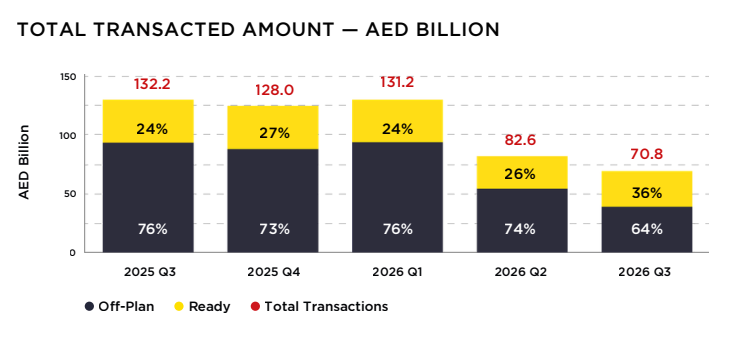
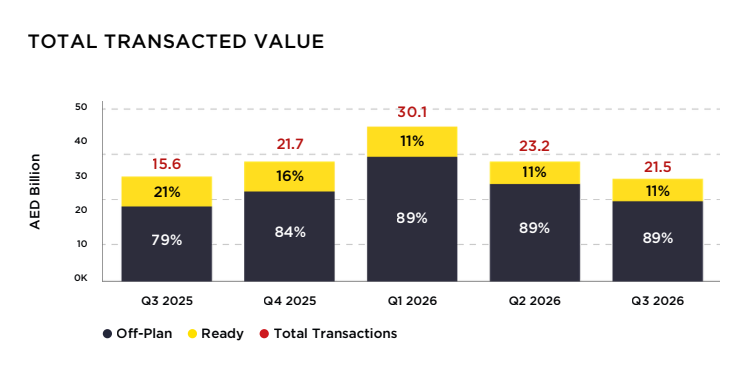
Two things stand out.
Dubai is still more than three times bigger. It lost about Dh65 billion of sales value on last year. Abu Dhabi gained about Dh5 billion. Abu Dhabi did not take Dubai’s buyers.
And both are off-plan markets. Abu Dhabi actually relies on off-plan more than Dubai does. So “Dubai is too speculative” doesn’t explain the gap.
The number that explains it: new homes per person
Dubai’s Land Department expects about 365,000 new homes by 2030. Dubai has 4.58 million residents. That’s roughly 80 new homes for every 1,000 people.
Abu Dhabi expects between 40,510 (ValuStrat) and 68,000 (Savills) by 2030, for 4.14 million people. That’s 10 to 16 per 1,000.
Use one source for both cities and the gap gets bigger. Savills counts more than 525,000 Dubai homes scheduled for 2027 to 2030. That’s about 115 per 1,000, against 16 in Abu Dhabi.
Abu Dhabi doesn’t even build what it plans. Of about 13,534 homes expected this year, only 3,508 were finished by the end of September.
Picture two bakeries. One bakes 80 loaves for every 1,000 customers. The other bakes 12. If half the customers stay home for a month, the first has to discount to clear its shelves. The second barely notices. That was 2026.
We’ve seen both versions before
Singapore releases land twice a year and says openly that it will “calibrate the release” of supply to keep prices stable. Abu Dhabi is closer to that model. A few big master developers set the pace, and the largest, Aldar, is 28% owned by state fund Mubadala.
Austin, Texas, is the other version. Developers added almost 50,000 rental homes in 2023 and 2024, a 14% jump in supply. Asking rents then fell 22% from the peak. The new homes came faster than the renters.
Dubai looks more like Austin. People keep arriving: 226,885 of them in the first nine months of this year, war included. But many developers launch projects aggressively.
Abu Dhabi’s win is narrower than it looks
Fewer homes were sold in Abu Dhabi in Q3 than a year earlier, 7% fewer. The value went up because each sale got bigger:
The average off-plan deal hit Dh5 million, up 40%
Sales over Dh10 million more than doubled to 582
95% of those were off-plan
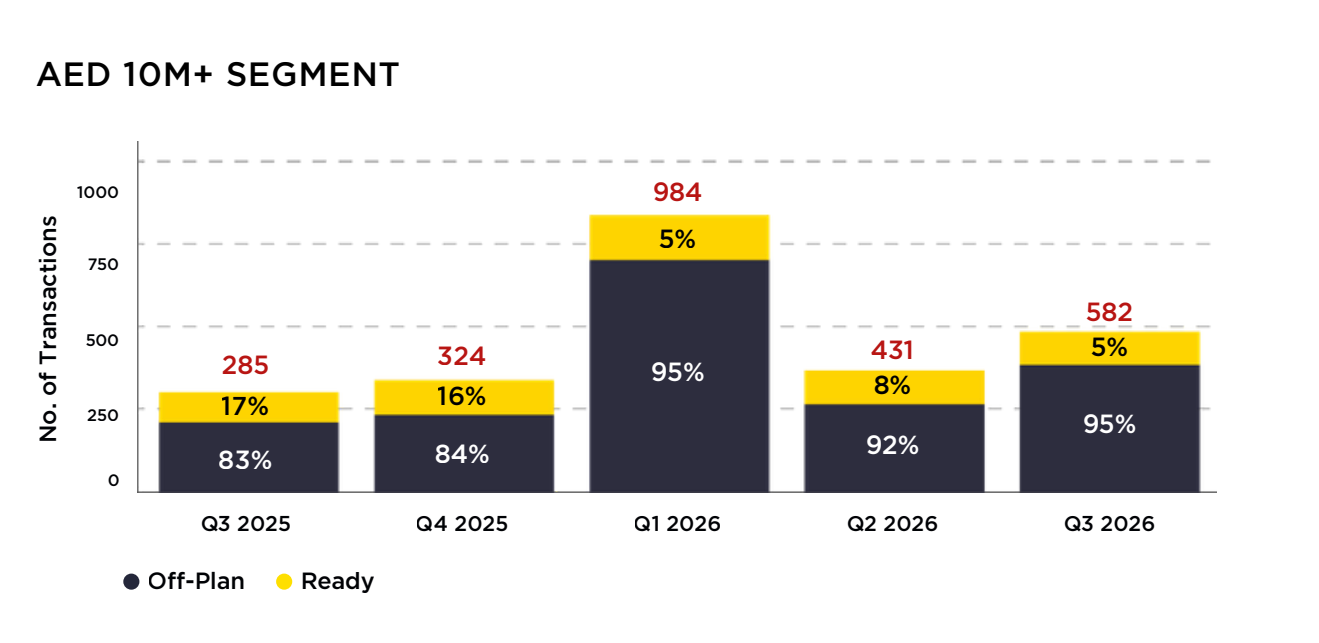
Most of that money is foreign. Foreign buyers made up 70% of Abu Dhabi sales value in the first half. At Aldar, 78% of UAE sales went to expat and overseas buyers. Even so, Aldar’s own UAE sales fell 45% in Q3.
Then there’s the rent freeze. Since 2 June, most Abu Dhabi landlords can’t raise rents at all, down from a 5% cap, “until further notice”. Apartment rents rose 1.5% in a year while prices rose 24%. Buyers are paying a lot more for income that can’t grow.
The risk nobody is modelling: Abu Dhabi’s prices rest on a small group of wealthy, mostly foreign buyers, with rents frozen by law. If those buyers slow down, there’s no rent growth to soften the fall.
Dubai renters are now better off moving
Dubai’s slowdown shows up most clearly in rents. And it isn’t hitting everyone the same way.
For three years, Dubai tenants renewed because moving cost more. That has flipped:
In July and August, new leases outnumbered renewals for the first time in 36 months
New-lease rents in the same buildings were 15.3% below January. Renewal rents were roughly flat.
Apartment listings on Property Finder were up 55% on last year, with 23% fewer enquiries each
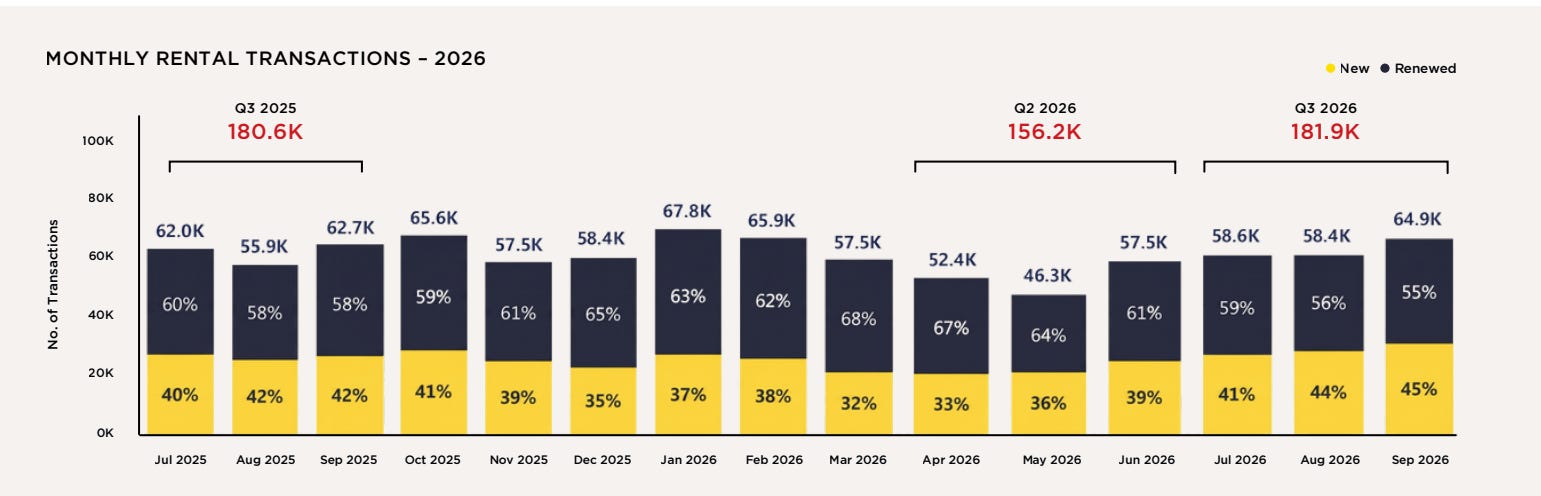
The biggest falls are at the top. Downtown asking rents fell about 22% in a year, and Dubai Marina about 16%. In some cheaper areas, such as Me’Aisem First and Al Warsan, new-lease rents went up.
Demand hasn’t gone anywhere. Freehold rental contracts hit 339,557 from January to October, up 6.8% and on course for a record. Tenants just have more choice.
What to learn: last year’s renewal rent is now the wrong number to underwrite in Dubai. The new-lease rent in the same building is the real one. (That’s the comparison we built Buildable to make in minutes.)
Why Aldar is buying Dubai land anyway
While Dubai sales fell by almost half, Abu Dhabi’s biggest developer kept buying in Dubai, mostly with Dubai Holding (The National):
Three projects launched: Haven, Athlon and The Wilds. First handovers next year.
February 2026: two plots, near Nad Al Sheba and on Palm Jebel Ali, for almost 14,000 homes worth over Dh38 billion.
By year end: a large villa and townhouse community near Dubai Silicon Oasis, reported as a Dh30 billion master plan.
Look at what it’s building: mostly villas and townhouses. I think that’s where Dubai’s new supply is thinnest. ValuStrat’s August index has Dubai villas only 1.7% down on a year, against 5.3% for apartments. As Aldar’s development chief put it: “The customers are still there for the right product.”
The developer that knows scarcity best isn’t avoiding Dubai. It’s buying the scarce part of it while everyone else is nervous.
Where I could be wrong
Abu Dhabi is small. A few hundred luxury deals can swing its totals. One quarter isn’t a trend.
Dubai may already be turning. October sales value rose about 18% on September. Apartment prices edged up 0.3% in September
Plans aren’t deliveries. If Dubai’s pipeline arrives as slowly as Abu Dhabi’s, the gap shrinks.
The freeze could backfire. A 0% cap protects tenants now, but it may put off the landlords and builders Abu Dhabi needs later.
What this means for the next ten years
For twenty years, the Gulf property story was about demand. More people, more money. That’s still true. But 2026 showed that when a shock hits, supply decides who holds up.
Three things I expect:
Scarce product wins inside Dubai. Villas, townhouses and hard-to-copy buildings hold their value. Generic towers in busy supply areas compete on price.
New-lease rents become the number to watch. They will show turning points months before the sales headlines do.
Abu Dhabi’s model gets copied, then tested. The test comes when foreign buyers slow down and rents are still frozen.
Who wins: owners of scarce Dubai product bought in this dip. Abu Dhabi landowners, while the buyers keep coming. Dubai renters, for now.
Who loses: anyone who bought a generic Dubai flat at the 2025 peak counting on last year’s rent. And late Abu Dhabi buyers paying 24% more for rent that can’t rise.
Dubai didn’t lose its demand this year. It found out what happens when everyone builds at once. Abu Dhabi didn’t win on demand either. It won by building less. And now its biggest developer is buying Dubai land.
Thanks for reading,
Zakee
I’m Zakee Ahmed. I head up projects and developments at the Parklane Group, and I’ve spent about ten years in residential real estate, from build-to-rent development and operations to proptech data.
I’m also the founder of Buildable, the AI partner for real estate firms. We help teams build their own internal AI layer, so their deals, data and operations run on systems they own. We’ve worked with firms including Brookfield.