

In June, Morgan Stanley and Ridgeback acquired a portfolio of 3,200 rental homes across London for £1.045 billion.
Ten days later, Greystar acquired 904 rental apartments at Elephant Park, for around £500 million.
Then in August, Border to Coast, one of the UK’s largest pension investment pools, agreed to acquire 866 single-family rental homes from Blackstone-backed Leaf Living for approximately £400 million.
That’s almost £2 billion changing hands across three transactions involving nearly 5,000 homes.
All three transactions involved existing rental portfolios. Not one directly financed the construction of a new home.
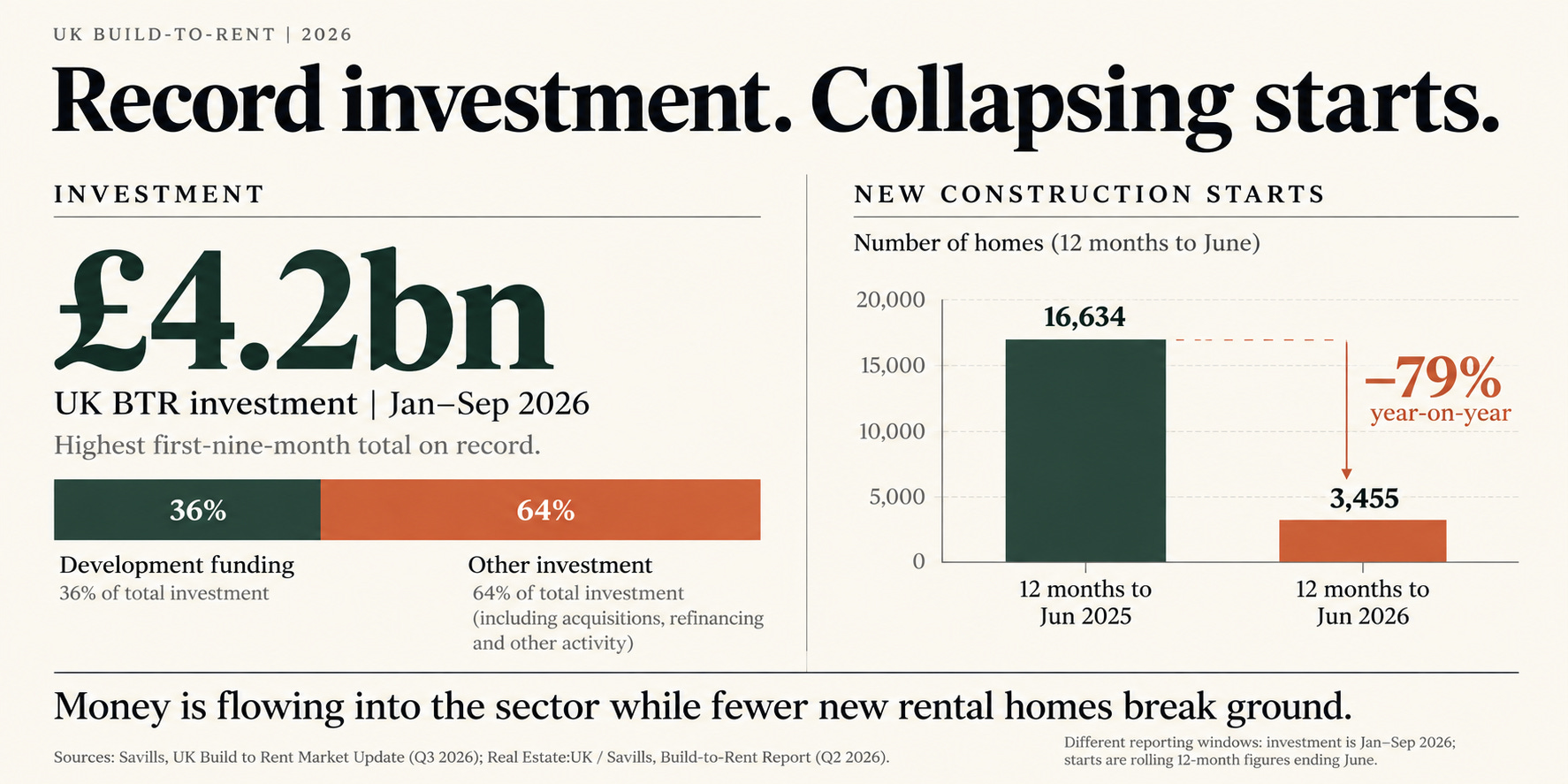
According to Savills’ latest research, approximately £4.2 billion has been invested in UK build-to-rent (BTR) during the first nine months of 2026, a record for this point in the year.
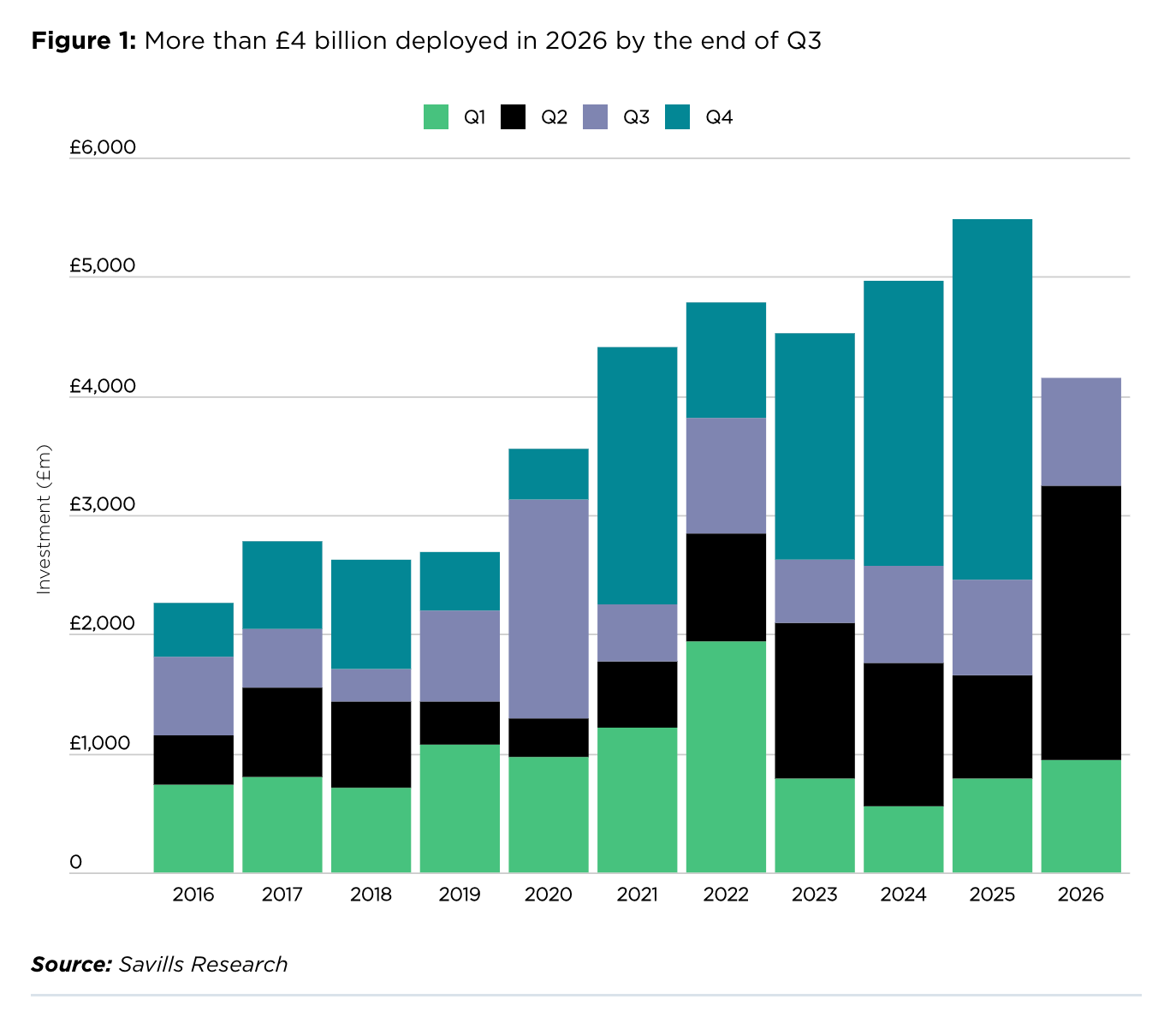
Yet new BTR construction starts have fallen 79% in the 12 months to June.
So we have billions flowing into rental housing, while the number of new homes being started has collapsed.
The obvious explanation is higher construction costs and financing rates. And that’s certainly part of it.
But after spending years developing and operating living accommodation through The Parklane Group, I think there’s something more interesting happening.
The economics of owning rental housing and the economics of developing it are becoming two very different things.
And that could fundamentally change who makes money in this sector.
Today’s Brief
The £4.2bn investment boom: Where institutional capital is going.
Why construction is collapsing: The development economics behind the 79% decline.
What investors are actually buying: The Blackstone, Morgan Stanley and Greystar playbooks.
Where the opportunity lies: Why the next generation of BTR developers may look very different.
1. The UK BTR Market Is Booming. Sort Of.
Let’s start with the numbers.
According to the Q2 2026 Build-to-Rent Report, prepared by Savills for Real Estate:UK, the UK now has:
156,688 completed BTR homes, with more in the pipeline.
50,362 homes under construction, down 21% year-on-year.
Just 3,455 new construction starts over the preceding 12 months, down 79%.
For ten consecutive quarters, more BTR homes have been completed than started.
That’s a pretty extraordinary statistic for a sector that’s supposed to be experiencing an institutional investment boom.
The completed market continues growing because developments started several years ago are finally being delivered. But the pipeline of projects replacing them is shrinking.
Meanwhile, Savills reports that only 36% of the £4.2 billion invested so far this year has gone towards development funding.
Much of the remaining investment has been directed towards existing assets and portfolios.
To be honest, there’s nothing wrong with that. A healthy investment market needs buyers and sellers.
But buying 1,000 existing apartments doesn’t create another 1,000 apartments.
It just changes who collects the rent.
And that distinction matters when discussing whether institutional capital can help solve the UK’s housing shortage.
2. Why the Numbers No Longer Work
The simplest way to understand what’s happening is to look at the economics of a BTR development.
Imagine you’re a developer considering a residential project.
You acquire land, secure planning, appoint a contractor and spend two or three years delivering the building.
Then you need to lease the apartments, stabilise the income and either hold the property or sell it to an institutional investor.
Unlike a traditional build-for-sale development, a BTR scheme doesn't usually have individual apartment sales waiting to repay development debt when construction finishes. Instead, the developer needs to lease the homes, stabilise the income and either refinance the building, retain it or sell it to an institutional investor.
That makes the financing structure particularly important.
And right now, developers are being squeezed from both sides.
Construction costs
According to Savills, UK construction costs have increased 36% since Q1 2020.
Developers are also dealing with additional building safety requirements, higher financing costs and planning delays.
Investment yields
At the same time, the amount an investor will pay for a completed rental building is determined largely by the income it produces and the yield that investor requires.
Here’s a simplified example.
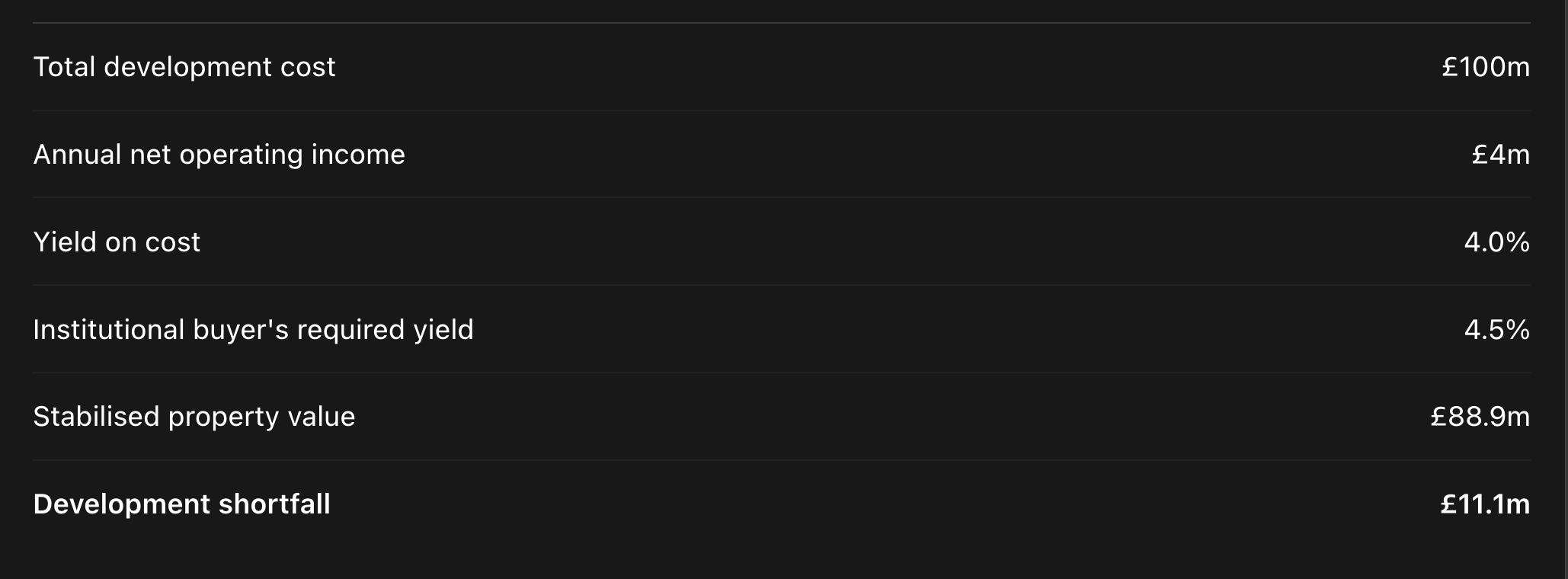
You’ve spent £100 million creating an asset that’s worth £88.9 million to your target buyer.
And that’s before allowing for a developer’s required profit.
These are illustrative figures, not an actual transaction, but they explain the problem in simple terms.
The building can be fully occupied, generating millions in rental income and delivering a perfectly acceptable return to the eventual owner.
Yet it can still be a terrible investment for the developer who built it.
To make the scheme work, something needs to change:
Land prices need to fall.
Construction or financing costs need to come down.
Rents or operating margins need to improve.
Investors need to accept lower acquisition yields.
Or the developer needs a different funding structure.
In practice, it’s usually a combination.
And none of these changes happen automatically just because pension funds want to own more rental housing.
A building can be an excellent investment at £89 million and a terrible development at £100 million.
That’s the distinction I think a lot of people miss when discussing BTR.
3. What Morgan Stanley and Greystar Are Really Buying

Now look at the transactions from earlier this year.
Morgan Stanley didn’t just acquire 3,200 apartments when it bought Metra Living.
It acquired a business that had been established in 2015, including its operating team and management platform.
The £1.045 billion enterprise value also included £300 million of external debt facilities, so it shouldn’t be confused with the cash price paid for the equity.
Over more than a decade, Metra Living had assembled a portfolio of rental housing across Greater London.
Morgan Stanley and Ridgeback acquired that established platform in a single transaction. (Gowling WLG)
Greystar’s Elephant Park acquisition follows a similar pattern.

The buildings were developed by a partnership between Lendlease and CPP Investments, with construction completed between 2021 and 2024.
By the time Greystar acquired them, the major development risks had largely been dealt with.
The buyer could focus on leasing, operating performance and long-term asset management rather than getting a building out of the ground.

These transactions highlight something important.
Institutional investors don’t necessarily want to be developers.
They want exposure to rental income.
Of course, Greystar itself is also a major developer, and Morgan Stanley has backed development strategies elsewhere. These aren’t companies that categorically avoid construction risk.
But there is a difference between their willingness to finance development and their appetite for buying completed assets at an acceptable valuation.
And the recent transaction volumes suggest there is plenty of money available for the latter.
4. The Blackstone Playbook
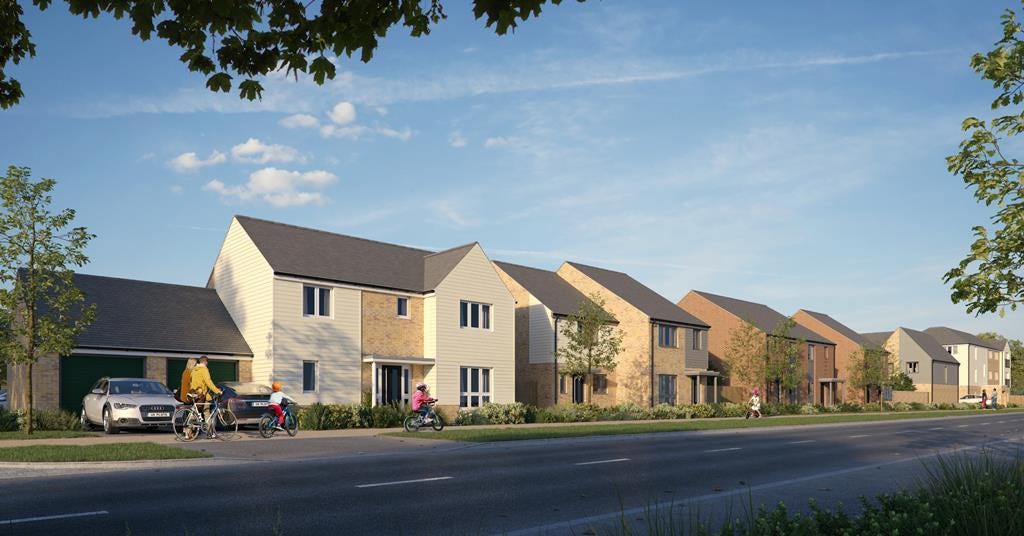
I find the Blackstone-backed Leaf Living transaction particularly interesting.
Leaf Living was established by Blackstone and Regis to build a portfolio of professionally managed family rental housing.
Rather than concentrating exclusively on high-rise apartment blocks in city centres, the business focused on suburban homes.
In August, Border to Coast acquired 866 of those homes across 12 estates for approximately £400 million.
The buyer was a pension investment pool seeking long-term exposure to rental housing.
The seller was a platform backed by private capital.
In my view, this represents a potentially important model for the sector.
Private capital can create and assemble an institutional rental portfolio. Pension capital can become its long-term owner.
They’re serving different functions in the same market.
One takes the risk of creating or assembling a portfolio and building an operating platform.
The other acquires an established asset base and collects the income.
It reminds me of how other real estate sectors have developed over time.
Student accommodation, logistics and hospitality all have businesses that specialise in development, while other investors focus on owning completed assets.
BTR is becoming increasingly sophisticated in the same way.
That doesn’t mean every private equity-backed rental platform will generate attractive returns. Without knowing Leaf Living’s full investment basis and financing costs, we can’t establish the profit generated from this particular sale.
But the transaction shows that institutional buyers are willing to acquire substantial portfolios from specialist platforms.
The question for developers is whether they can deliver those portfolios at a cost that leaves sufficient profit for both parties.
5. My Experience: The Operating Business Matters More Than People Think
One thing I’ve learned from working in the living sectors, including apart-hotels, student accommodation, and coliving through The Parklane Group, is that it’s easy to underestimate the importance of operations.
A developer might spend years modelling land costs, construction expenses and the expected exit value.
But once the building opens, performance comes down to a different set of decisions.
Occupancy, leasing costs, maintenance, staffing, utilities, resident experience and tenant retention all determine how much income the building actually generates.
And relatively small changes can have a substantial impact on value.
Take a 300-unit BTR building generating £5 million in annual net operating income.
If the operator can increase NOI by 5% through better leasing, cost control and operational efficiencies, that’s another £250,000 of annual income.
At a 4.5% yield, the additional income represents approximately £5.6 million of property value.
That doesn’t require constructing another apartment.
It requires running the existing ones more efficiently.
I think this helps explain why sophisticated operators are becoming increasingly valuable to institutional investors.
A completed rental building with weak operations might offer an opportunity to increase income, improve the tenant experience and create value.
That can be more attractive than funding an entirely new development, where much of the return depends on construction costs and the eventual stabilised valuation.
Of course, there is a limit to what operations can achieve. You can’t simply cut maintenance and staffing indefinitely without eventually damaging the asset and its rental performance.
But the underlying point remains.
Good development creates the building. Good operations determine how valuable that building becomes.
And as more institutional money enters rental housing, I expect the distinction between developers, operators and long-term owners to become increasingly important.
6. So Who’s Going to Build the Next Generation of Rental Homes?
This is where I think the opportunity lies.
If institutional investors have billions available to acquire rental housing, but developers are struggling to finance new schemes, the industry needs better ways to connect those two sides of the market.
We may see more businesses built around three distinct models.
1. Developer-operator partnerships
Specialist developers identify land, secure planning and manage construction. Institutional investors provide capital and potentially acquire the asset upon completion.
2. Forward-funded developments
Investors commit capital before construction is complete, providing developers with greater funding certainty and reducing the risk of having to find an exit buyer later.
3. Asset-light development platforms
Rather than owning every building permanently, development businesses earn fees, participate in development profits and potentially retain management agreements.
There are already examples of capital moving in this direction.
In May, the UK’s National Housing Bank announced a £100 million cornerstone investment into Starlight Investments’ second UK BTR fund.
The fund is intended to support a pipeline of approximately 6,000 rental homes across England.
Importantly, this is a commitment designed to support the creation of new housing, rather than simply the acquisition of existing rental portfolios.
It’s a different model from the Morgan Stanley transaction.
And it suggests that public-sector capital, specialist development expertise and institutional investment could increasingly work together to make schemes viable.
That said, new funding structures aren’t a magic solution.
If a development costs more to deliver than its completed investment value, introducing another investor doesn’t solve the underlying problem.
Someone still has to accept the lower return, contribute cheaper land, reduce costs or improve the project’s income.
The strongest developers will be those that can actually close that gap.
7. Where This Could Go Wrong
I don’t think the UK is experiencing some permanent collapse in BTR development.
The 79% fall in starts is a dramatic number, but construction starts can be volatile. A handful of large projects moving between reporting periods can materially change the annual figures.
The more telling statistic is probably the 21% decline in homes under construction, alongside ten consecutive quarters in which completions have exceeded starts.
And there are several reasons the market could recover.
First, acquisition demand can eventually stimulate development. If more institutional investors compete for completed buildings, values may rise enough to make new construction viable again.
Second, development funding hasn’t disappeared. It still accounts for 36% of BTR investment this year, with some investors particularly interested in suburban single-family housing.
Third, new supply could become increasingly valuable. If construction remains depressed for several years while rental demand holds up, a shortage of completed homes could support rental growth and valuations.
That final point is interesting because it creates a potentially uncomfortable outcome.
The same conditions making new BTR development unattractive today could eventually benefit the investors buying existing properties.
Lower construction activity means less competing supply.
Less competing supply can support occupancy and rental growth.
And stronger rental income can increase the value of existing buildings.
Not indefinitely, of course. Rental affordability, regulation and economic conditions still matter.
But it creates a situation where the owners of completed rental housing may benefit from the development constraints faced by everyone else.
8. What Happens Next?
My view is that BTR will continue attracting institutional capital.
The underlying investment proposition remains compelling: professionally managed rental housing, recurring income and long-term demand for somewhere to live.
But I think the industry needs to stop treating institutional investment and housing development as if they’re the same thing.
They’re not.
We’ve now reached a point where billions can flow into the sector without creating a meaningful increase in housing supply.
That isn’t necessarily a failure of investors. They’re buying assets at prices and yields that work for their capital.
The challenge belongs to the developers, landowners, lenders and policymakers responsible for making new projects economically viable.
And there may be an opportunity for a new generation of businesses capable of doing exactly that.
Businesses that don’t necessarily aspire to own thousands of apartments permanently, but know how to create, finance and operate rental housing that institutional investors want to acquire.
That’s the part of the market I’d be watching.
Because the next big opportunity in build-to-rent might not be owning more rental homes. It might be figuring out how to make building them profitable again.
Thanks for reading.
Zakee